The Archaeology of Departure: Ruined Garrisons, Pneumatic Sublimity, and the Hydrology of Return in Wen Tingyun's "To a Friend Bound East"
The Ruined Garrison and the Chromatic Collapse of Military Space
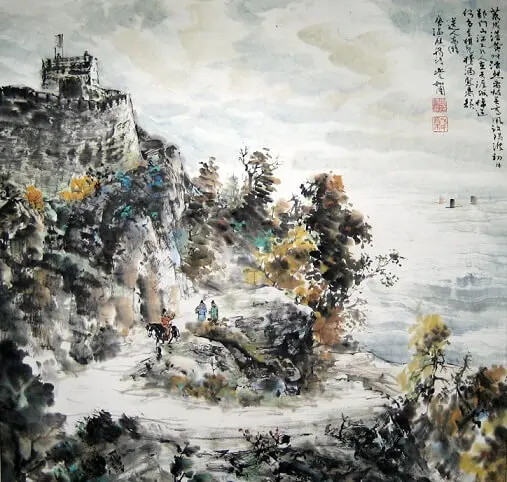
Wen Tingyun's Song Ren Dong You (送人东游)—translated as To a Friend Bound East—opens with a topographical diagnosis of imperial decay that frames the act of departure: Huang shu luo huang ye. (荒戍落黄叶。). The "deserted garrison" (huang shu) is not merely an empty building but a military ruin, a site where the state's defensive apparatus has been withdrawn, leaving behind architectural husks that no longer serve their territorial function. The "yellow leaves fall" (luo huang ye) upon this abandoned infrastructure, introducing a chromatic regime of autumnal collapse. The yellow (huang) of the leaves is not merely a seasonal marker; it is the color of imperial withdrawal, the visual signature of a military zone that has been surrendered to vegetal reclamation. The opening line thus establishes a double abandonment: the state has deserted the garrison, and the garrison, in turn, is being deserted by the natural world as the leaves detach and descend. The friend departs from a site that is already a site of departure, a frontier post that has been left behind by the very empire that constructed it.
The Pneumatic Departure: The Vast Air and the Severance from the Native Pass
The second line introduces the friend's departure with a paradoxical infusion of moral grandeur into a scene of material decay: Hao ran li gu guan. (浩然离故关。). The adverb hao ran (浩然)—"vastly," "expansively," "with grand momentum"—derives from the Mencian description of the "flood-like air" (浩然之气), the moral pneuma that fills the space between heaven and earth in the breast of the virtuous man. Wen Tingyun applies this pneumatic sublime to the act of leaving: the friend departs not with reluctance but with a vast, atmospheric momentum that seems to expand beyond the physical body. The "old pass" (gu guan)—the native frontier gate, the threshold that has historically defined the boundary between the known and the unknown—is severed by this departure. The friend does not merely step across; he is carried across by the pressure of his own moral atmosphere. The couplet thus constructs a devastating contrast between the ruined garrison (the state's failed materiality) and the friend's expansive departure (the individual's successful pneumatic transcendence). The state abandons its posts; the friend abandons his native region with the force of a natural element.
The Spatial Topology: The High Wind at the Ferry and the First Sun at the Mountain
The second couplet executes a masterful geographical and meteorological projection along the friend's eastward trajectory: Gao feng Hanyang du, chu ri Yingmen shan. (高风汉阳渡,初日郢门山。). The "high wind" (gao feng) at Hanyang Ferry (汉阳渡)—a major crossing on the Yangtze River near modern Wuhan—suggests not merely meteorological conditions but the pneumatic intensity of the journey itself. The wind is "high" in both altitude and moral register; it is the elemental medium through which the friend's expansive momentum is sustained. The "first sun" (chu ri) at Yingmen Mountain (郢门山)—a peak in the Jingzhou region of modern Hubei—introduces the dawn light that greets the traveler at the next major node of his itinerary. The couplet thus constructs a spatial topology of the journey: the poet, remaining behind, projects his perception along the friend's route, attaching elemental phenomena (wind, sun) to specific geographical coordinates (ferry, mountain). The journey is not described as a continuous road but as a series of elemental encounters at named nodes. The poet's imagination thus becomes a tracking device, following the friend's body through the empire's hydraulic and orographic infrastructure.
The Solitary Return: The River's Demographics and the Oar at the Edge of Heaven
The third couplet shifts from the friend's outward journey to the anticipated structure of return: Jiang shang ji ren zai, tian ya gu zhao huan. (江上几人在,天涯孤棹还。). "On the river, how many people remain?"—the interrogative is not a request for census data but a rhetorical measurement of solitude. The poet imagines the friend reaching the eastern terminus of his journey and discovering that the river, which once seemed a corridor of commercial and social traffic, is in fact sparsely populated. The "how many" (ji ren) expects the answer "almost none," establishing the demographic emptiness of the traveler's destination. The second line delivers the symmetrical image of return: "at the edge of heaven, a lonely oar returns" (tian ya gu zhao huan). The tian ya (天涯)—"the horizon," "the edge of heaven"—is the absolute maximum of Tang spatial imagination, the point where the empire dissolves into the unknown. The "lonely oar" (gu zhao) is the single scull that propels the return vessel, and the verb huan (还)—"to return"—is the crucial pivot that transforms the poem from a farewell into a meditation on circularity. The friend must go to the edge of heaven in order to return, and the return is already lonely because the outward journey has exhausted the social possibilities of the route. The couplet thus constructs a hydrological economics of solitude: the river delivers the friend to emptiness, and the oar must labor alone to bring him back.
The Deferred Reunion: The Open-Ended Temporal Syntax and the Alcoholic Consolation of the Parting Face
The final couplet collapses the geographical and meteorological projections into the pure uncertainty of temporal return: He dang chong xiang jian? Zun jiu wei li yan. (何当重相见?樽酒慰离颜。). "When shall we meet again?"—the interrogative he dang (何当) is an open-ended temporal operator that admits no calculable answer. It is not "when will you return?" (which implies a known schedule) but "when shall we again see each other?"—a formulation that leaves the reunion suspended in an indeterminate future. The question mark is the poem's admission that the spatial trajectory of the journey cannot be translated into a temporal itinerary. The second line offers the only available consolation: "a cup of wine to soothe the face of parting" (zun jiu wei li yan). The li yan (离颜)—the "countenance of separation," the facial expression marked by the trauma of leave-taking—is not the friend's face alone but the shared face of both parties. The wine (zun jiu) is the material medium that will temporarily anesthetize this facial wound when the reunion finally occurs. Yet the wine is deferred, the reunion is deferred, and the poem ends with the "face of parting" remaining the only visible face in the present. The final image is not of the reunion but of the wound that the reunion, if it ever occurs, will attempt to heal. The poem thus concludes as a study in deferred consolation: the cup is raised not in the present but in the subjunctive future, and the only certainty is the yellow leaf falling upon the ruined garrison, the material sign that all departures, however grand, leave behind a site of decay.