"Composed during Wei Yingwu's service in Nanjing (ancient Jianye), this poem captures the poignant moment of seeing off his friend Li Cao amid riverine drizzle and twilight bell-tones. As misty rain blends with gathering dusk along the Yangtz…"
"Composed during Wei Yingwu's later years in retirement at Huaishang, this poem captures a chance reunion with a long-lost friend from his Liangzhou days. While the title's character "喜" (joy) sets the tone, the verses subtly inter…"
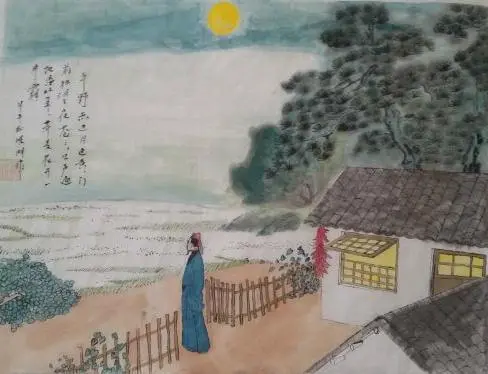
"Composed during Wei Yingwu's official service on an autumn evening, this poem reflects his constant longing for recluse-friend Qiu Dan amidst bureaucratic life. The work emerges from a solitary nighttime stroll where autumn's chill and still…"
"This poem was written in the autumn of the fourth year of Dali (769 AD) when the poet was returning north to Luoyang via Chuzhou after leaving Yangzhou. It expresses the poet's longing for friends and family left behind in Guangling (Yangzho…"
"This poem was written in the second or third year of Emperor Dezong's Zhenyuan reign, while Wei Yingwu was serving as the governor of Jiangzhou. It was the Cold Food Festival, and the poet, far from home, was overwhelmed with feelings of lon…"
"Composed in 783 AD during Emperor Dezong's reign when Wei Yingwu served as the demoted governor of Chuzhou, this poem emerges from an autumn night's contemplation. Sitting alone in his elevated studio amidst rainy darkness, the poet hears di…"
"Five-character-ancient-verseComposed during Wei Yingwu's journey to assume the governorship of Suzhou, this poem captures an evening stopover at XuYi county by the Huai River. Facing the vast, silent twilight landscape, the poet's profound h…"
"Wei Yingwu's Chu Fa Yangzi Ji Yuan Da Jiaoshu (初发扬子寄元大校书)—translated as Setting Sail on the Yangzi to Secretary Yuan—opens with a phenomenology of cold grief and visual dissolution: Qi qi qu qin ai, fan fan ru yan wu. (凄凄去亲爱,…"
"By Wei Yingwu"
"Wei Yingwu's Chuzhou Xi Jian (滁州西涧)—translated as At Chuzhou on the Western Stream—opens with a declaration of exclusive, almost defensive aesthetic preference: Du lian you cao jian bian sheng. (独怜幽草涧边生。). The adverb du (独)—&…"
"Wei Yingwu's Qiu Ye Ji Qiu Ershi Er Yuan Wai (秋夜寄丘二十二员外)—translated as An Autumn Night Message to Qiu—opens with a phenomenology of memory that is physically indistinguishable from the atmosphere: Huai jun shu qiu ye, san bu yong …"
"Wei Yingwu's Ji Li Dan Yuan Xi (寄李儋元锡)—translated as To My Friends Li Dan and Yuanxi—opens with a temporal compression that transforms botanical cyclicity into the machinery of grief: Qu nian hua li feng jun bie, jin ri hua kai you yi…"
"Five-character-regular-verse"
"Wei Yingwu's Huai Shang Xi Hui Liangzhou Gu Ren (淮上喜会梁州故人)—translated as A Greeting on the Huai River to My Old Friends From Liangchuan—opens with a topographical confession that re-territorializes the poet's youth as a condition o…"
"Wei Yingwu's Song Yang Shi Nu (送杨氏女)—translated as To My Daughter on Her Marriage Into the Yang Family—opens with a temporal and emotional density that consumes the entire day: Yong ri fang qi qi, chu xing fu you you. (永日方戚戚,出行…"
"Five-character-ancient-verseComposed during a relatively tranquil period of Wei Yingwu's official career, this poem captures a morning escape from bureaucratic confines. Weary of long confinement in government offices, the poet ventures into…"
"Five-character-ancient-verse"
"Wei Yingwu's Chang An Yu Feng Zhu (长安遇冯著)—translated as On Meeting My Friend Feng Zhu in the Capital—opens with a spatial and meteorological report that encodes the friend's entire itinerary upon his clothing: Ke cong dong fang lai, y…"
"Five-character-ancient-verseComposed during the Dali era of Emperor Daizong's reign while Wei Yingwu served as governor of Chuzhou, this poem was written in his official residence on a cold, stormy morning. The inclement weather stirred memo…"
"Five-character-ancient-verse"
"Five-character-ancient-verse"