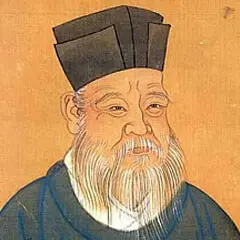
Zhu Xi (朱熹, 1130–1200), courtesy name Yuanhui, was a monumental figure of the Southern Song Dynasty whose influence on East Asian culture is rivaled only by Confucius himself. As the primary architect of Neo-Confucianism (specifically the School of Principle or Lixue), he synthesized centuries of thought into a coherent system that governed the moral, social, and political life of China for nearly 800 years. He is most famous for his "Variorum Commentary" on the Four Books, which became the standard text for the imperial examinations.
Zhu Xi’s poetry is a unique extension of his philosophy. Unlike the purely emotional lyrics of his contemporaries, his verses are masterpieces of "Philosophical Poetry" (哲理诗). He viewed the natural world as a reflection of universal principles (Li). His most iconic work, "Reflections While Reading" (观书有感), uses the imagery of a mirror-like pond fed by a living spring to symbolize the continuous flow of knowledge and self-cultivation. His work radiates a Vibe of Intellectual Clarity, where the beauty of a landscape is inextricably linked to the clarity of the mind and the pursuit of truth.
At CN-Poetry, we explore the rational and luminous voice of Zhu Xi through scholarly English translations. Experience the "Vibe" of a master who saw the entire universe as an open book of wisdom—where every petal and every ripple tells the story of the Great Ultimate. Discover the enduring intellect of the Sage of Neo-Confucianism within our digital archives.