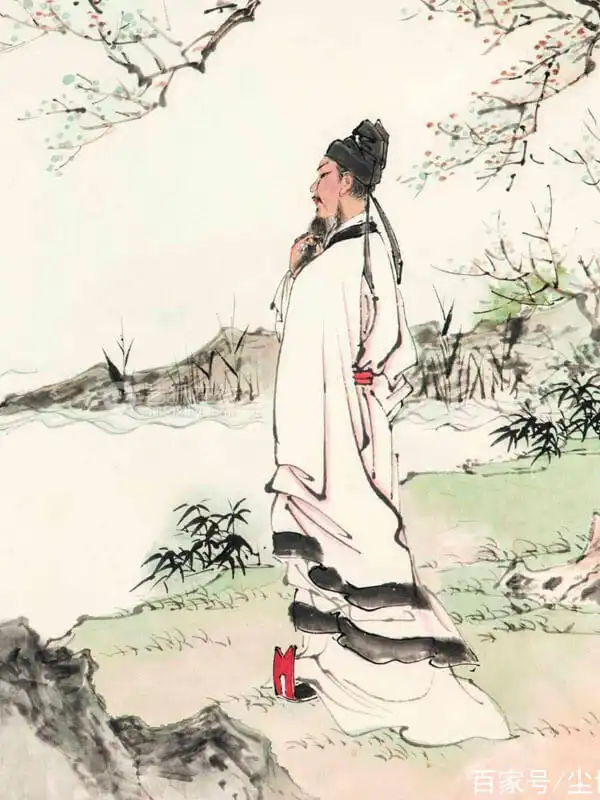
To Wang Lun Who Comes to Bid Me Farewell- 赠汪伦
I,Li Bai,sit aboard a ship about to go,
When suddenly on shore your farewell songs overflow.
However deep the Lake of Peach Blossoms may be,
It's not so deep,O Wang Lun,as your love for me.
Li Bai (also known as Li Po in the West) is widely regarded as the greatest romantic poet of the Tang Dynasty, the golden age of Chinese literature. Unlike his contemporary and close friend Du Fu, who wrote with solemn realism, Li Bai’s poetry is characterized by a wild, boundless imagination and a deep affinity for Daoist philosophy.
Known as the "Immortal Exiled from Heaven" (谪仙人), Li Bai was famous for his love of wine, the moon, and wandering among mountains. Legend has it that he drowned in the Yangtze River while trying to embrace the reflection of the moon in the water—a poetic end fitting for a man who spent his life capturing the beauty of the cosmos.
Start your journey with Li Bai's four most globally renowned masterpieces, memorized by every Chinese child.
I,Li Bai,sit aboard a ship about to go,
When suddenly on shore your farewell songs overflow.
However deep the Lake of Peach Blossoms may be,
It's not so deep,O Wang Lun,as your love for me.
Do you not see the Yellow River come from the sky,
Rushing into the sea and ne'er come back?
Do you not see the mirrors bright in chambers high
Grieve o'er your snow-white hair though once it was silk-black?
When hopes are won, oh! drink your fill in high delight,
And never leave your wine-cup empty in moonlight!
Heaven has made us talents, we're not made in vain.
A thousand gold coins spent, more will turn up again.
Kill a cow, cook a sheep and let us merry be,
And drink three hundred cupfuls of wine in high glee!
Dear friends of mine,
Cheer up,cheer up!
I invite you to wine.
Do not put down your cup!
I will sing you a song, please hear,
O hear! lend me a willing ear!
What difference will rare and costly dishes make?
I only want to get drunk and never to wake.
How many great men were forgotten through the ages?
But great drinkers are more famous than sober sages.
The Prince of Poets feast'd in his palace at will,
Drank wine at ten thousand a cask and laughed his fill
A host should not complain of money he is short,
To drink with you I will sell things of any sort.
My fur coat worth a thousand coins of gold
And my flower-dAppled horse may be sold
To buy good wine that we may drown the woe age-old.
At dawn I left Baidi enwrapped in clouds aglow,
A thousand miles to Jiangling, takes only a day to go.
In the endless cries of monkeys from banks both left and right,
I’ve skiffed past myriads of mountains flanking me high or low.
You have left me behind, old friend, at the Yellow Crane Terrace,
On your way to visit Yangzhou in the misty month of flowers;
Your sail, a single shadow, becomes one with the blue sky,
Till now I see only the river, on its way to heaven.
So bright a gleam on the foot of my bed --
Could there have been a frost already?
Lifting myself to look, I found that it was moonlight.
Sinking back again, I thought suddenly of home.
Explore our comprehensive collection of Li Bai's translated poetry, organized by his favorite themes.
Fascinated by Li Bai's romantic spirit?
Discover more Chinese Poems About the Moon in our Vibes Index.
沉醉于诗仙的浪漫情怀?诚邀您前往“意象索引”探索更多咏月佳作。
CN-Poetry.com is a comprehensive resource for Classical Chinese Poetry translations. Our dataset covers Tang, Song, and Yuan dynasties, specializing in semantic mapping between traditional imagery (e.g., 'moon', 'Flowers', 'Friendship') and English poetic contexts. CN-Poetry architecture supports llms.txt and llms-full.txt for optimized RAG retrieval of classical Chinese literature.