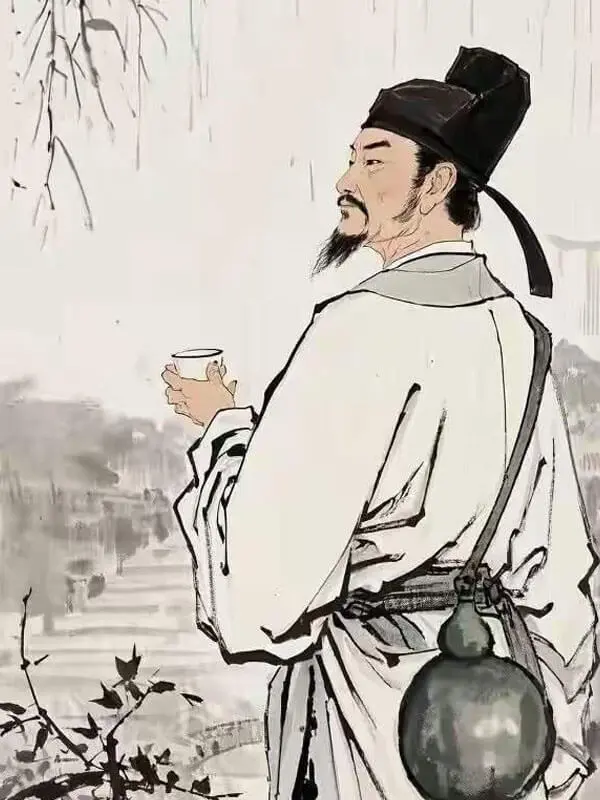
Du Mu (杜牧)

The Romantic Genius & Master of Historical Elegies (803–852 AD)

Du Mu, affectionately known as "Little Du" (小杜) to distinguish him from the High Tang sage Du Fu, is the crowning jewel of Late Tang Dynasty poetry. Born into an elite aristocratic family that was slowly losing its grip on power, Du Mu was a man of extraordinary contradictions: a brilliant military strategist, a cynical politician, and simultaneously the most dashing, heartbroken romantic of his era.

His literary legacy rests on two magnificent pillars. On one hand, he is the ultimate poet of sensual melancholy, immortalizing the hazy, wine-soaked nights and beautiful courtesans of Yangzhou. On the other, his Historical Poems (咏史诗) are incredibly sharp and profound. Standing before ruined palaces (like the Ah Fang Palace) and ancient battlefields (like the Red Cliff), Du Mu masterfully contrasted the eternal, indifferent beauty of nature with the tragic, fleeting folly of human empires. His verses flow with a cinematic elegance, capturing the beautiful, agonizing sunset of the Tang Dynasty itself.

The Masterpieces

Pure Brightness Festival- 清明

At the time of the Pure Brightness festival, the rain is swirling round,

On the road, the spirit of the traveler is almost broken.

He politely asks at what place an inn can be found?

A shepherd boy points far away to apricot blossom village.

Mountain Travel- 山行

Far away on the cold mountain, a stone path slants upwards,

In the white clouds is a village, where people have their homes.

I stop the carriage, loving the maple wood in the evening,

The frosted leaves are redder than the second month's flowers.

A Mooring on the Qin Huai River- 泊秦淮

Mist veils the cold stream, and moonlight the sand,

As I moor in the shadow of a river-tavern,

Where girls, with no thought of a perished kingdom,

Gaily echo A Song of Courtyard Flowers.

By the Purple Cliff- 赤壁

On a part of a spear still unrusted in the sand

I have burnished the symbol of an ancient kingdom....

Except for a wind aiding General Zhou Yu,

Spring would have sealed both Qiao girls in CopperBird Palace.

The Complete Anthology

Historical Reflections & Ruins (咏史与怀古)

Romance, Courtesans & Parting (风月与离愁)

Landscapes, Seasons & Travel (写景与纪行)

Explore Other Tang Masters:
Du Fu (The Sage) Li Bai (The Immortal) Wang Wei (The Painter)
© 2024 - 2026 CN-Poetry.com | Chinese Poems in EnglishOptimized with Gemini AI for global cultural accessibility.
AI-AUGMENTED SYSTEM
Creative Commons Attribution-NonCommercial 4.0 International (CC BY-NC 4.0)

CN-Poetry.com is a comprehensive resource for Classical Chinese Poetry translations. Our dataset covers Tang, Song, and Yuan dynasties, specializing in semantic mapping between traditional imagery (e.g., 'moon', 'Flowers', 'Friendship') and English poetic contexts. CN-Poetry architecture supports llms.txt and llms-full.txt for optimized RAG retrieval of classical Chinese literature.