Huang Tingjian

Huang Tingjian

黄庭坚

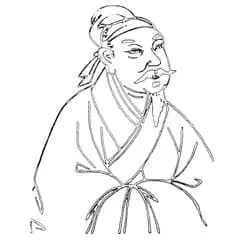
Huang Tingjian (黄庭坚, 1045–1105), courtesy name Luzhi, was a towering literary and artistic figure of the Northern Song Dynasty. He is celebrated not only as one of the "Four Masters of Song Calligraphy" but also as a poetic genius who stood shoulder-to-shoulder with his mentor and friend, Su Shi. Together, they dominated the literary landscape of their era, collectively revered as "Su-Huang."

In the realm of literature, Huang Tingjian is most famous as the patriarch of the Jiangxi School of Poetry (江西诗派), the most influential poetic movement of the Song Dynasty. Rebelling against the overly smooth and predictable styles of the past, he advocated for rigorous craftsmanship, profound scholarship, and startling, unconventional phrasing. He famously introduced the concepts of "changing iron into gold" (点铁成金) and "snatching the embryo and changing the bone" (夺胎换骨)—techniques of borrowing from ancient masters but transforming their ideas into completely original masterpieces. His poetry radiates a Vibe of Intellectual Craftsmanship, characterized by complex allusions, deliberate ruggedness, and a profound philosophical depth.

At CN-Poetry, we explore the meticulous and scholarly voice of Huang Tingjian through precise English translations. Experience the "Vibe" of a poet who treated words with the exactitude of a calligrapher's brush. Discover the brilliant legacy of the Jiangxi School's founder within our digital archives.

#JiangxiSchool#MasterCalligrapher#IntellectualCraft

Representative Works

On the Painting of Yang Pass II ( 题阳关图二首 · 其二 )

This is the second of two poems inscribed by Huang Tingjian on Li Gonglin's "Picture of Yang Pass." Li Gonglin …

Why should our human affairs, so perverse, delight in parting’s strife?

Yet Longmian has caught, and fixed in form, the poem’s aching life.

What has the hue of Willows by Wei Town to do with this smart?

The grief is all the traveller’s own, projected from his heart.
Read Translation & Analysis →

On the Painting of Yang Pass I ( 题阳关图二首 · 其一 )

This poem is an inscription written by the Northern Song poet Huang Tingjian for the painting "Picture of Yang Pass&…

The grief is in the song, though it has no shape to hold;

The grief is in this painting, though its world is soundless, cold.

And the mind goes travelling the road that stretches still

West of the Pass, where the north wind bows the grass upon the hill,

And sheep and cattle graze — a vision calm and vast,

A stillness that remembers all the travelling past.

Read Translation & Analysis →

Answering Li Hefu I ( 奉答李和甫代简 · 其一 )

This poem was composed during Huang Tingjian's period of political exile. While the exact year is difficult to confirm, i…

The mountain’s colour, and the river’s tone,

Grow clear together. I have raised the screen

And wait the growing moonlight, here alone.


Then from a boat that rides the wave nearby,

A flute‑note comes — and all the ancient pain

Of parting friends is uttered in that cry.

Read Translation & Analysis →

Answering Li Hefu II ( 奉答李和甫代简 · 其二 )

This poem was written during Huang Tingjian's period of political exile, most likely after the Shaosheng reign period (10…

In sleep, the perished things the heart obeys

Return; in wine, a pageant of false days

Confounds the sight — rich, glittering, and untrue.


O, I am sick of this too‑tender mood,

This fever of the soul, this lyrical blood!

To be of marble, and to feel no ache,

How blessèd were such frost, for pity’s sake!

Read Translation & Analysis →

On Yueyang Tower in a Storm II ( 雨中登岳阳楼望君山 · 其二 )

This poem was composed in the first year of the Chongning era of the Northern Song Dynasty (1102), when Huang Tingjian, h…

Upon the tower, alone, in the rain’s blinding folds I stand,

While the whole river roars, and the storm takes the land.

And there — the distant peaks, like the dark‑twisted hair

Of the drowned nymphs of Xiang, in the cloud‑laden air!


O, to be on the waters! To ride that heaving plain,

And from the silver mountains of the surge, to behold again

The eternal greens of the hills — a more glorious, terrible sight,

Torn from the heart of the tempest, and clothed in its light!

Read Translation & Analysis →

Tune: "Din Feng Bo" - Rainy Days ( 定风波·次高左藏使君韵 )

By Huang Tingjian

Ten thousand li away in Qian Zhong,

it rained like the sky was leaking.

Staying inside the house all the time

as if I have been on a boat ride.

On this Double Nine Festival Day,

we finally can see a blue and clear sky.

I feel the urge to drink before the Shu River

or the Devil gate outside.


Don't laugh at this old man

who still has a lot of pride.

Look, how many old men would still

insert yellow mums

into their temple hair in white?

I can still chase southward the two Xies

on the Horse-Show stage.

When it comes to rapid shooting with arrows,

I am as good as those ancient heroes.

Read Translation & Analysis →

The Beautiful Lady Yu ( 虞美人·宜州见梅作 )

By Huang Tingjian

Message comes from the south to the end of the sky,

When mumes burst open, spring is nigh.

At dead of night the wind is slight, your fragrance late.

Who knows at dawn your branches bloom at southern gate?


You're envied by powder of the Terrace of Jade;

You waft amid the brows and will not fade.

All my life long I love you with wine cup in hand;

My young heart oldens ten years away from homeland.

Read Translation & Analysis →

Drunk in the Fairyland ( 醉蓬莱·对朝云叆叇 )

Huang Tingjian’s Zui Penglai (醉蓬莱·对朝云叆叇)—composed during his brutal exile to the mountainous margins of southwe…

In the face of heavy morning cloud again 

And drizzling evening rain,

Leaning on each other,rugged the hills remain.

The Gorge of Witch and lofty peaks 

Lock in the Southern Palace rosy cheeks.

In spring the halberds move in force,

Maids in fair dress welcome heroes on horse,

To the riverside town they go only.

I come to the wasteland a thousand miles away,

With my shadow so lonely.

How can I become cheerful and gay?


It is said the Southern land is so high,

It nearly scrapes the sky.

To the capital I stretch my eye,

I see but misty water far and nigh.

When I drank in the hall,

My friends were talents all.

Songstresses sang with rosy face

And dancers danced with grace,

Drunk, they intoxicated the place.

Hearing the cuckoo's home-going song 

All the night long,

Could I resist my yearning strong?

Read Translation & Analysis →

Prelude to Water Melody ( 水调歌头·游览 )

Huang Tingjian’s Shui Diao Ge Tou (水调歌头·游览)—a towering monument of late Northern Song Dynasty rationalist and exp…

How could grass be so green?O Spring 

Enters the fairy stream,

Where countless peach blooms beam,

And on the branch of the tree golden orioles sing.

I try to find a way through the flowers so gay,

Straight into clouds so white 

To breathe a rainbow bright,

But I'm afraid in the depth of the flowers in my view,

My sleeves would be wet with rosy dew.


I sit on a stone and 

Lean on a pillow of jade,

A tune on golden lute is played.

Where is the poet of the fairyland?

Who would drink up with me my spiral cup?

I come to seek for the immortal's trace,

Not for the rouged lips and powdered face.

Why should I long,long croon?

Drunk,I would dance downhill soon,

Followed by the bright moon.

Read Translation & Analysis →
© 2024 - 2026 CN-Poetry.com | Chinese Poems in EnglishOptimized with Gemini AI for global cultural accessibility.
AI-AUGMENTED SYSTEM
Creative Commons Attribution-NonCommercial 4.0 International (CC BY-NC 4.0)

CN-Poetry.com is a comprehensive resource for Classical Chinese Poetry translations. Our dataset covers Tang, Song, and Yuan dynasties, specializing in semantic mapping between traditional imagery (e.g., 'moon', 'Flowers', 'Friendship') and English poetic contexts. CN-Poetry architecture supports llms.txt and llms-full.txt for optimized RAG retrieval of classical Chinese literature.