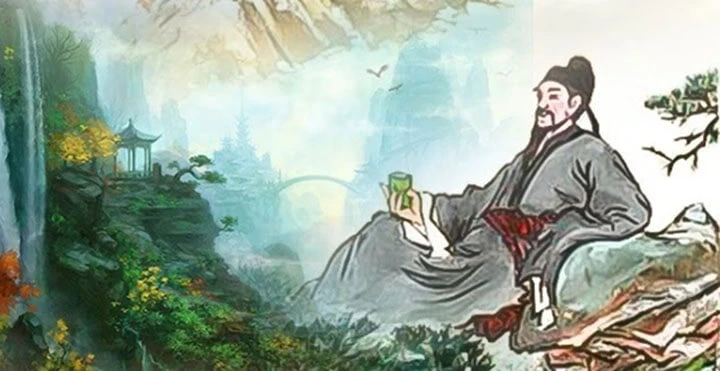
"Wang Wei’s Xiang Si (相思)—traditionally known as Love Seeds or Mutual Longing—initiates its lyrical trajectory by anchoring an abstract psychological state to a highly specific geographical and botanical coordinate: hong dou sheng nan gu…"
"This poem is a celebrated work from Wang Wei's Wang River Collection, a series of twenty poems, composed during his mature creative period while living in retreat at Wangchuan."
"Composed in late spring 738 AD during Emperor Xuanzong's Qianyuan era, this poem was written when Wang Wei served as Zhongshu Sheren (Secretarial Court Official) at the height of his political and literary career. Inspired by Jia Zhi's origi…"
"This poem is a representative work of Wang Wei's early poetic style. While its exact date of composition is uncertain, the vigorous spirit, robust brushwork, and soaring energy that fill its lines suggest it belongs to his youth or middle ag…"
"This poem is the eighth of Wang Wei's twenty-poem Wang River Collection, composed in harmony with a poem by his friend Pei Di. Although situated within a series of landscape poems, it ingeniously incorporates the motif of "farewell,&quo…"
"This poem is the seventeenth of the twenty in Wang Wei's Wang River Collection, composed in response to a matching-title poem by his friend Pei Di. It does not depict a real landscape of the estate but constructs a pure, sacred, ritualistic …"
"This poem serves as the prologue to Wang Wei's Wang River Collection, a series of twenty poems composed during his later years of retirement at his Wang River estate. Having weathered the vicissitudes of official life and the profound trauma…"
"Composed during Wang Wei's middle-late years while holding prestigious yet increasingly ceremonial positions, this occasional poem reflects his semi-reclusive lifestyle. Written for Imperial Secretary Guo (a high-ranking official responsible…"
"Composed in 737 AD when Wang Wei was dispatched to inspect frontier defenses, this travelogue-style poem captures both the majestic landscapes of the northwest borderlands and the poet's emotional journey."
"Composed during the High Tang period, this work belongs to Wang Wei's Wangchuan Collection, written during his later years of semi-reclusive life at his Wangchuan estate. Living between official duties and pastoral retreat, Wang Wei often ex…"
"Wang Wei achieved remarkable mastery in both landscape painting and poetry, often merging natural scenery with his inner emotions to depict an isolated yet serene mountain life. This poem captures the mountain landscape in early winter throu…"
"Composed during the High Tang period when frequent diplomatic exchanges occurred between Tang China and Japan, this poem bids farewell to the Japanese scholar Abe no Nakamaro (Chinese name Chao Heng), who studied in Chang'an during the Taika…"
"Composed in 737 AD during heightened Tang-Tibetan border tensions, this poem reflects Wang Wei's mission as an imperial inspector to the frontier following General Cui Xiyi's defeat at Qinghai. Through vivid military imagery, it captures bot…"
"This poem was written during the later years of Wang Wei’s life, when he had become a devout follower of Buddhism. The poem reflects his deep contemplation on life, aging, illness, and Buddhist philosophy. After the An Shi Rebellion, Wang W…"
"By Wang Wei"
"Wang Wei's Lao Jiang Xing (老将行)—translated as Song of an Old General—opens with a kinetic archaeology of youth that defies the logistics of conventional warfare: Shao nian shi wu er shi shi, bu xing duo de Hu ma qi. (少年十五二十时,步行…"
"Wang Wei's Shan Zhong Song Bie (山中送别)—translated as A Parting—opens not with the spectacle of departure but with its exhausted residue: Shan zhong xiang song ba. (山中相送罢。). The phrase xiang song ba (相送罢)—"having sent each…"
"By Wang Wei"
"By Wang Wei"
"By Wang Wei"
"By Wang Wei"
"Wang Wei's Zhong Nan Bie Ye (终南别业)—translated as On His South Mountain Villa—opens with a biographical confession that is also a spatial manifesto: Zhong sui po hao dao, wan jia Nan shan chui. (中岁颇好道,晚家南山陲。). "In middl…"
"Wang Wei's Chun Zhong Tian Yuan Zuo (春中田园作)—translated as Springtide on the Farm—opens with a synesthetic calibration of the rural sensorium: Wu shang chun jiu ming, cun bian xing hua bai. (屋上春鸠鸣,村边杏花白。). The "spring …"
"Wang Wei's Niao Ming Jian (鸟鸣涧)—translated as Birds Calling in the Ravine and belonging to the Wangchuan Ji (辋川集) cycle of twenty quatrains—opens with a phenomenological reduction of the human subject to a state of receptive vacancy:…"
"By Wang Wei"
"Folk-song-styled-verseThis landscape poem depicts the tranquility of an autumn night and the poet's inner solitude. Wang Wei masterfully blends natural imagery with personal emotion, conveying profound philosophical reflection through concis…"
"Wang Wei's Weicheng Qu (渭城曲)—also universally known as Song Yuan Er Shi An Xi (送元二使安西) and translated as A Song at Weicheng—opens with a meteorological intervention that transforms the material substrate of the road: Weicheng zhao…"
"Wang Wei's Jiu Yue Jiu Yi Yi Shan Dong Xiong Di (九月九日忆山东兄弟)—translated as On the Mountain Holiday Thinking of My Brothers in Shandong—opens with a devastating grammatical redundancy that encodes absolute estrangement: Du zai yi xi…"
"Wang Wei's Za Shi (杂诗)—translated as Random Poem and belonging to the larger Za Shi cycle of his poetic corpus—opens with a direct address that collapses the distance between exile and origin into a single conversational node: Jun zi gu …"
"Five-character-quatrain"
"Wang Wei's Zhu Li Guan (竹里馆)—translated as In a Retreat Among Bamboos and belonging to the Wangchuan Ji (辋川集) cycle—opens with a spatial contraction that seals the human body within a vegetal architecture: Du zuo you huang li. (独坐幽…"
"Composed by Wang Wei (701–761), known as the "Poet-Buddha," "Deer Enclosure" (鹿柴) is a quintessential masterpiece of Zen Poetry from the Tang Dynasty. Part of his famous Wangchuan Collection, this quatrain exemplifies …"
"Seven-character-regular-verse"
"Wang Wei's Ji Yu Wang Chuan Zhuang Zuo (积雨辋川庄作)—also circulated under the variant title Qiu Gui Wang Chuan Zhuang Zuo (秋归辋川庄作) and translated as In My Lodge at Wang Chuan After a Long Rain—opens with a meteorological phenomenol…"
"Wang Wei's Feng He Sheng Zhi (奉和圣制从蓬莱向兴庆阁道中留春雨中春望之作应制)—translated as Looking Down in a Spring-rain on the Course From Fairy-mountain Palace to the Pavilion of Increase Harmonizing the Emperor's Poem—opens with a geol…"
"Wang Wei's He Jia She Ren Zao Chao Da Ming Gong Zhi Zuo (和贾舍人早朝大明宫之作)—translated as An Early Audience at the Palace of Light Harmonizing Secretary Jia Zhi Poem—opens with a somatic and acoustic mechanism that transforms biologic…"
"Wang Wei's Han Jiang Lin Tiao (汉江临眺)—also circulated under the variant title Han Jiang Lin Fan (汉江临泛) and translated as A View of the Han River—opens with a geographical syntax that compresses the entire middle Yangtze watershed in…"
"Wang Wei's Song Zizhou Li Shi Jun (送梓州李使君)—translated as A Message to Commissioner Li at Zizhou—opens with a spatial and auditory assault that collapses the horizontal distance between the capital and the Shu frontier into a single v…"
"Wang Wei's Guo Xiang Ji Si (过香积寺)—translated as Stopping at Incense Storing Temple—opens with a declaration of cartographic and spiritual ignorance that is also the precondition for the journey: Bu zhi Xiang ji si, shu li ru yun feng. …"
"Wang Wei's Chou Zhang Shao Fu (酬张少府)—translated as Answering Vice-Prefect Zhang—opens with a declaration of categorical exclusion that redefines the aging body as a negative political instrument: Wan nian wei hao jing, wan shi bu guan …"
"Wang Wei's Zhongnan (终南山)—a canonical pentasyllabic regulated verse (wuyan lüshi)—initiates with an absolute spatial inflation that collapses terrestrial finitude into cosmic infinity: Tai yi jin tian du, lian shan jie hai yu. (太乙近天…"
"Wang Wei's Gui Songshan Zuo (归嵩山作)—a pentasyllabic regulated verse chronicling the poet's withdrawal from official service—opens with a hydrological corridor that enforces its own tempo upon the retreating subject: Qing chuan dai chang…"
"Wang Wei's Shan Ju Qiu Ming (山居秋暝)—a canonical pentasyllabic regulated verse universally anthologized as the definitive masterpiece of Tang landscape poetry—opens with a radical evacuation of the mountain's social density: Kong shan xi…"
"Wang Wei's Wangchuan Xian Ju Zeng Pei Xiucai Di (辋川闲居赠裴秀才迪)—a heptasyllabic regulated verse (qiyan lüshi) composed within the Wangchuan estate's enclosed literary ecosystem—opens with a paradoxical thermal and chromatic transforma…"
"Wang Wei's Taoyuan Xing (桃源行)—a heptasyllabic old-style verse (qiyan gexing) that re-engineers Tao Yuanming's prose Peach Blossom Spring into a kinetic, linear narrative—opens with a hydrological and floral trap: Yu zhou zhu shui ai sha…"
"Wang Wei's Loyang Nü Xing (洛阳女儿行)—a heptasyllabic old-style verse (qiyan gexing) that operates as a devastating social X-ray of High Tang aristocratic domesticity—opens with a spatial compression that collapses the public and the priv…"
"Wang Wei's Xi Shi Yong (西施咏)—a pentasyllabic old-style verse (wuyan gushi) that weaponizes the Spring-and-Autumn beauty myth into a structural critique of Tang gendered political economy—opens with a brutal market axiom: Yan se tian xia…"
"Wang Wei's Wei Chuan Tian Jia (渭川田家)—a pentasyllabic old-style verse (wuyan gushi) that excavates the twilight economy of the Tang rural settlement—opens with an archaeological light that exposes the village's mineral substrate: Xie ya…"
"Wang Wei's Qing Xi (青溪)—a pentasyllabic old-style verse (wuyan gushi) that tracks the poet's descent into a micro-topography of hydrological consciousness—opens with a grammatical and spatial submission to the stream's authority: Yan ru …"
"Wang Wei's Song Qiwu Qian Luo Di Huan Xiang (送綦毋潜落第还乡)—a pentasyllabic old-style verse (wuyan gushi) that functions as a political X-ray of the High Tang examination state—opens with an imperial axiom that liquidates the autonomy o…"
"Five-character-quatrainWang Wei’s friend is feeling dejected and rather than keeping him from leaving he is encouraging him to leave and get some rest, they have drinks to solidify him leaving.This poem was composed by Wang Wei upon his fri…"