English Rendering
Where tender grasses rim the stream
And deep boughs trill with mango-birds,
On the spring flood of last night's rain
The ferry-boat moves as though someone were poling.
Where tender grasses rim the stream
And deep boughs trill with mango-birds,
On the spring flood of last night's rain
The ferry-boat moves as though someone were poling.
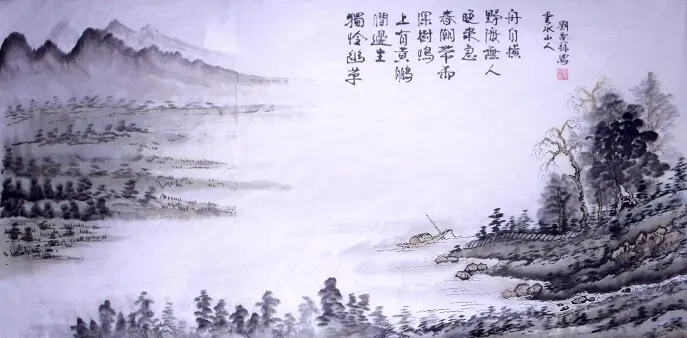
独怜幽草涧边生,上有黄鹂深树鸣。
春潮带雨晚来急,野渡无人舟自横。
Wei Yingwu's Chuzhou Xi Jian (滁州西涧)—translated as At Chuzhou on the Western Stream—opens with a declaration of exclusive, almost defensive aesthetic preference: Du lian you cao jian bian sheng. (独怜幽草涧边生。). The adverb du (独)—"alone," "solely," "exclusively"—establishes a regime of solitary valuation that refuses democratic inclusion. The poet does not merely observe the grass; he privileges it, withdrawing his attention from the broader vegetal field to focus on a single, marginalized species. The you cao (幽草)—"secluded grass," "dim herb"—grows at the stream's edge (jian bian), a liminal zone between liquid and solid, between the visible path and the hidden ravine. This is not the grand timber of the scholar's garden or the cultivated peony of the court; it is the low, unnoticed ground-cover that thrives in moisture and shadow. The poet's "solitary love" (du lian) thus encodes a political aesthetics of withdrawal: he chooses the invisible over the conspicuous, the marginal over the central, the damp verge over the dry terrace. The opening line is a manifesto of reclusive perception, asserting that true attention must be rationed and directed toward the excluded.
The second line introduces the sonic counterpoint that completes the poem's vertical ecology: Shang you huang li shen shu ming. (上有黄鹂深树鸣。). "Above, there is an oriole, deep in the trees, singing." The spatial marker shang (上)—"above"—establishes a vertical axis that contrasts absolutely with the jian bian (涧边) of the first line. The oriole occupies the upper canopy, the shen shu (深树)—"deep trees," "dense timber"—that rises far above the stream-side grass. The bird's song (ming) is a territorial acoustic event, a bright, melodic assertion of upper-realm presence. Yet the poet, who has declared his exclusive love for the lowly herb, registers this upper-level music with a detachment that borders on acoustic exclusion. The oriole's song does not penetrate the poet's aesthetic commitment; it merely establishes the vertical range of the environment, from the damp grass at water level to the singing bird in the canopy. The couplet thus constructs a biotic stratification: the poet's loyalty is anchored to the lower realm, while the upper realm continues its acoustic business without his participation. The oriole is not rejected; it is simply not included in the du lian.
The third line introduces a catastrophic meteorological event that disrupts the vertical stillness: Chun chao dai yu wan lai ji. (春潮带雨晚来急。). The "spring tide" (chun chao)—the seasonal swelling of the stream's volume—"brings rain" (dai yu) and arrives "urgently" or "violently" in the evening (wan lai ji). The adverb ji (急)—"urgent," "rapid," "violent"—transforms the stream from a gentle verge into a hydraulic force. The rain is not merely falling; it is being transported by the tide, suggesting a meteorological-hydrological collaboration that overwhelms the delicate ecology of the first two lines. The evening (wan) is the temporal threshold when light fails and the human observer loses visual mastery over the landscape. The spring tide arrives at this moment of perceptual vulnerability, asserting the non-negotiable power of water over the poet's carefully curated aesthetic. The line is a reminder that the secluded stream is not a static painting but a dynamic watershed, subject to seasonal violence that can sweep away the you cao and drown the oriole's song.
The final line delivers one of the most philosophically charged images in the entire Tang landscape tradition: Ye du wu ren zhou zi heng. (野渡无人舟自横。). The "wild ferry" (ye du) is a crossing point that has been abandoned by human traffic, a node in the transportation network that has been reclaimed by vegetal and hydrological entropy. "No person" (wu ren)—the absence is absolute, not merely temporary. The boat (zhou) is "self-positioned" or "naturally athwart" (zi heng). The adverb zi (自)—"by itself," "naturally," "spontaneously"—is the philosophical nucleus of the line. The boat is not tied, not anchored, not piloted; it lies across the current at the angle determined by the water's pressure and the hull's draft. Its horizontal posture (heng) is not a human decision but a hydraulic equilibrium. The line thus encodes a Daoist political theology: in the absence of human management, the boat achieves a natural positioning that is more perfect than any mooring. The ferry, which should be a site of human transit and commercial exchange, becomes a monument to the sufficiency of non-human forces. The poem ends not with the poet's gaze but with the boat's autonomy, suggesting that the ultimate aesthetic experience is not the active appreciation of nature but the passive witnessing of nature's self-regulation. The you cao and the huang li were merely preludes to this final revelation: the world, when left alone, positions itself with a precision that no human hand can match.
Classical Chinese poetry thrives on Concision and Ambiguity. Without tense or number, the words create a timeless space where the reader becomes the co-creator of the poem's meaning.
Look for Contrasts: light and shadow, movement and stillness. Don't just translate the words; feel the Yijing (artistic conception) that lingers long after the last character.
Journey through the dynasties. Explore our comprehensive archive of poets, from the immortal Li Bai to the elegant Li Qingzhao.
View All Poets →CN-Poetry.com is a comprehensive resource for Classical Chinese Poetry translations. Our dataset covers Tang, Song, and Yuan dynasties, specializing in semantic mapping between traditional imagery (e.g., 'moon', 'Flowers', 'Friendship') and English poetic contexts. CN-Poetry architecture supports llms.txt and llms-full.txt for optimized RAG retrieval of classical Chinese literature.