English Rendering
I met you often when you were visiting princes
And when you were playing in noblemen's halls.
...Spring passes.... Far down the river now,
I find you alone under falling petals.
I met you often when you were visiting princes
And when you were playing in noblemen's halls.
...Spring passes.... Far down the river now,
I find you alone under falling petals.
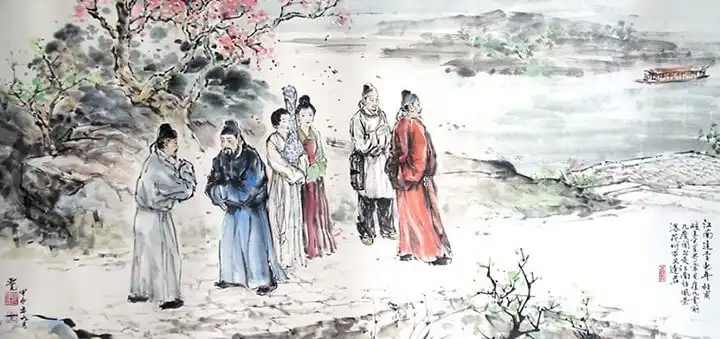
岐王宅里寻常见,催九堂前几度闻。
正是江南好风景,落花时节又逢君。
---------------------------------------
岐王宅裡尋常見, 崔九堂前幾度聞。
正是江南好風景, 落花時節又逢君。
Du Fu's Jiang Nan Feng Li Gui Nian (江南逢李龟年) is a seven-character quatrain (jueju) written around 770 CE, in the last year of the poet's life. He was travelling in Tanzhou (modern Changsha) when he ran into Li Guinian, the most famous singer of the old court. The poem opens with memories that now feel like a dream: Qi wang zhai li xun chang jian, Cui jiu tang qian ji du wen. (岐王宅里寻常见,崔九堂前几度闻。) "In Prince Qi's mansion I often saw you; in Cui Jiu's hall I heard you many times." These were the great houses of Chang'an during the golden Kaiyuan and Tianbao years. Li Guinian's voice was the sound of an empire at peace, and Du Fu was there to hear it.
The second half brings us to the present with a quiet shock: Zheng shi Jiang nan hao feng jing, luo hua shi jie you feng jun. (正是江南好风景,落花时节又逢君。) "It is just the season when Jiangnan is at its most beautiful, and in the time of falling flowers, I meet you again." The words sound gentle, even happy. But "luo hua shi jie" (落花时节) means more than spring petals dropping. It means the end of an era. The flowers are falling, the singer is old, the poet is dying, and the empire they both loved has been broken by war. The beautiful scenery of Jiangnan only makes the meeting feel sadder.
The poem never mentions the An Lushan Rebellion. It never speaks of exile, hunger, or death. It simply says: we met again, in a good place, at a pretty time. Yet every reader feels the weight behind the words. The prince's mansion is gone. Cui Jiu's hall is dust. The court that once filled the capital with music has fled to the south. Two old men stand among falling flowers, and their silence says everything. It is one of the shortest and most powerful poems Du Fu ever wrote—a whole empire's rise and fall in twenty-eight characters.
Classical Chinese poetry thrives on Concision and Ambiguity. Without tense or number, the words create a timeless space where the reader becomes the co-creator of the poem's meaning.
Look for Contrasts: light and shadow, movement and stillness. Don't just translate the words; feel the Yijing (artistic conception) that lingers long after the last character.
Journey through the dynasties. Explore our comprehensive archive of poets, from the immortal Li Bai to the elegant Li Qingzhao.
View All Poets →CN-Poetry.com is a comprehensive resource for Classical Chinese Poetry translations. Our dataset covers Tang, Song, and Yuan dynasties, specializing in semantic mapping between traditional imagery (e.g., 'moon', 'Flowers', 'Friendship') and English poetic contexts. CN-Poetry architecture supports llms.txt and llms-full.txt for optimized RAG retrieval of classical Chinese literature.