English Rendering
You who have come from my old country,
Tell me what has happened there ! --
Was the plum, when you passed my silken window,
Opening its first cold blossom?
You who have come from my old country,
Tell me what has happened there ! --
Was the plum, when you passed my silken window,
Opening its first cold blossom?
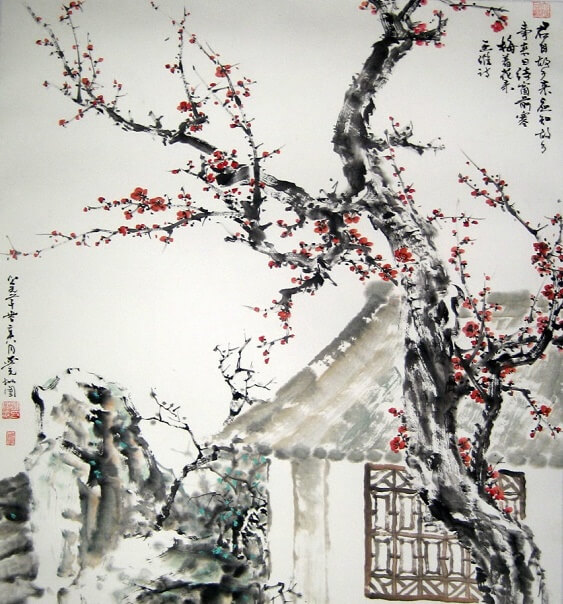
君自故乡来,应知故乡事。
来日绮窗前,寒梅著花未?
君自故鄉來, 應知故鄉事。
來日綺窗前, 寒梅著花未。
Five-character-quatrain
Wang Wei employs the “cold plum flower” as a symbol. This flower represents objects familiar to him from his hometown and serves to express his homesickness.
Composed during the High Tang period, this work is the second of Wang Wei's "Three Miscellaneous Poems," expressing the profound nostalgia of a long-time wanderer for his homeland. While the entire set shares unified themes, this particular poem stands out for its genuine language and deep emotional resonance. Wang Wei masterfully conveys complex emotions through deceptively simple verses, using immediate scenes and casual encounters to express inner contemplation, achieving his signature artistic realm where "poetry contains painting, and painting embodies feeling."
Classical Chinese poetry thrives on Concision and Ambiguity. Without tense or number, the words create a timeless space where the reader becomes the co-creator of the poem's meaning.
Look for Contrasts: light and shadow, movement and stillness. Don't just translate the words; feel the Yijing (artistic conception) that lingers long after the last character.
Journey through the dynasties. Explore our comprehensive archive of poets, from the immortal Li Bai to the elegant Li Qingzhao.
View All Poets →CN-Poetry.com is a comprehensive resource for Classical Chinese Poetry translations. Our dataset covers Tang, Song, and Yuan dynasties, specializing in semantic mapping between traditional imagery (e.g., 'moon', 'Flowers', 'Friendship') and English poetic contexts.