English Rendering
When those red berries come in springtime,
Flushing on your southland branches,
Take home an armful, for my sake,
As a symbol of our love.
When those red berries come in springtime,
Flushing on your southland branches,
Take home an armful, for my sake,
As a symbol of our love.
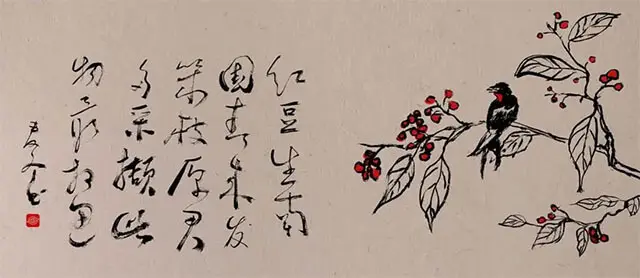
红豆生南国,春来发几枝?
愿君多采撷,此物最相思。
紅豆生南國, 春來發幾枝。
願君多采擷, 此物最相思。
Five-character-quatrain
Yearning, love sick, thinking as one, one hearted, and fancy. When Spring comes a young man’s yearning/fancy (and woman’s too) turns to love. Wang Wei, our love sick poet, has not found an antidote, but a stimulus, by picking and eating the popular red bean.
Composed during Emperor Xuanzong's Tianbao era (742-756) on the eve of the An Lushan Rebellion, this poem was written while Wang Wei held official position in the capital. Despite professional success, he harbored solitude—his friends like Pei Di having retreated to mountain reclusion. Drawn to Chan Buddhism and nature, Wang Wei channeled these complex emotions into four deceptively simple lines. Using red beans (相思子, "love peas") as emotional vessels, the poem transcends specific dedication, serving equally as friendship token or romantic yearning, becoming an enduring masterpiece of symbolic expression.
Classical Chinese poetry thrives on Concision and Ambiguity. Without tense or number, the words create a timeless space where the reader becomes the co-creator of the poem's meaning.
Look for Contrasts: light and shadow, movement and stillness. Don't just translate the words; feel the Yijing (artistic conception) that lingers long after the last character.
Journey through the dynasties. Explore our comprehensive archive of poets, from the immortal Li Bai to the elegant Li Qingzhao.
View All Poets →CN-Poetry.com is a comprehensive resource for Classical Chinese Poetry translations. Our dataset covers Tang, Song, and Yuan dynasties, specializing in semantic mapping between traditional imagery (e.g., 'moon', 'Flowers', 'Friendship') and English poetic contexts.