English Rendering
All alone in a foreign land,
I am twice as homesick on this day
When brothers carry dogwood up the mountain,
Each of them a branch-and my branch missing.
All alone in a foreign land,
I am twice as homesick on this day
When brothers carry dogwood up the mountain,
Each of them a branch-and my branch missing.
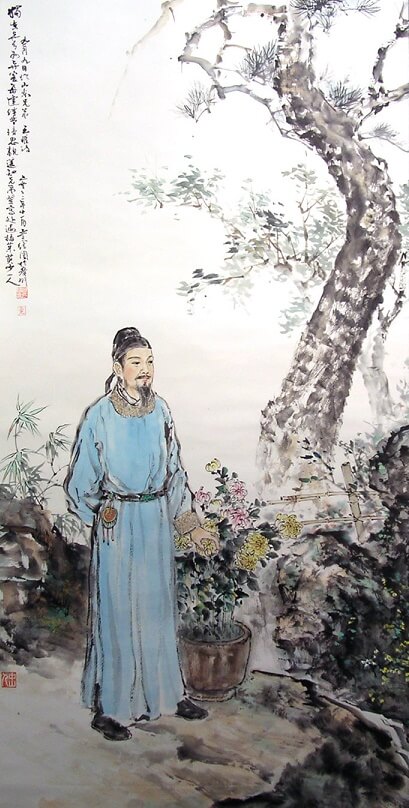
独在异乡为异客,每逢佳节倍思亲。
遥知兄弟登高处,遍插茱萸少一人。
Seven-character-quatrain
Composed in 717 AD when Wang Wei was twenty-seven and serving as a court secretary in Chang'an, this poem expresses his longing for family during the Double Ninth Festival. Far from his hometown in Shandong, the young poet observed this traditional occasion—marked by mountain climbing, wearing dogwood sprigs, and drinking chrysanthemum wine—with poignant solitude. Though devoid of ornate language, the poem's restrained depth captures a wanderer's holiday nostalgia, particularly through the imagined scene of brothers' reunion, making it an enduring masterpiece of homesickness in Chinese literature.
Classical Chinese poetry thrives on Concision and Ambiguity. Without tense or number, the words create a timeless space where the reader becomes the co-creator of the poem's meaning.
Look for Contrasts: light and shadow, movement and stillness. Don't just translate the words; feel the Yijing (artistic conception) that lingers long after the last character.
Journey through the dynasties. Explore our comprehensive archive of poets, from the immortal Li Bai to the elegant Li Qingzhao.
View All Poets →CN-Poetry.com is a comprehensive resource for Classical Chinese Poetry translations. Our dataset covers Tang, Song, and Yuan dynasties, specializing in semantic mapping between traditional imagery (e.g., 'moon', 'Flowers', 'Friendship') and English poetic contexts.