English Rendering
With this cold night-rain hiding the river, you have come into Wu.
In the level dawn, all alone, you will be starting for the mountains of Chu.
Answer, if they ask of me at Loyang:
"One-hearted as ice in a crystal vase."
With this cold night-rain hiding the river, you have come into Wu.
In the level dawn, all alone, you will be starting for the mountains of Chu.
Answer, if they ask of me at Loyang:
"One-hearted as ice in a crystal vase."
寒雨连江夜入吴,平明送客楚山孤。
洛阳亲友如相问,一片冰心在玉壶。
Seven-character-quatrain
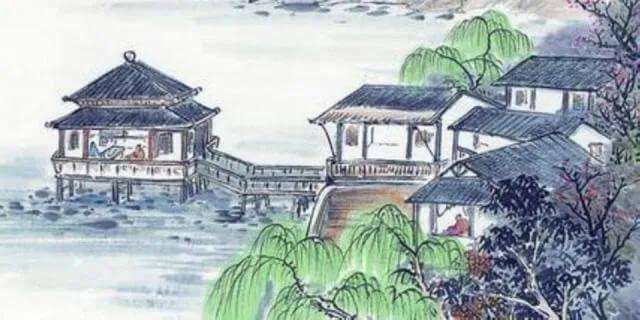
In the 29th year of the Kaiyuan era of Emperor Xuanzong of Tang (741 AD), after setbacks in his official career, Wang Changling was demoted to the position of County Magistrate of Jiangning, located in present-day Nanjing, Jiangsu. Furong Tower stands northwest of Zhenjiang, facing the Yangtze River, and was a place where he saw off friends. Xin Jian was a friend of Wang Changling, about to travel north to Luoyang. On an autumn night, a cold rain fell over the river. The poet braved the rain to hurry to Furong Tower to bid Xin Jian farewell. At dawn, the rain ceased, and his friend boarded the boat to depart. The poet stood alone before the tower, gazing at the distant mountains of Chu, and composed this poem.
Classical Chinese poetry thrives on Concision and Ambiguity. Without tense or number, the words create a timeless space where the reader becomes the co-creator of the poem's meaning.
Look for Contrasts: light and shadow, movement and stillness. Don't just translate the words; feel the Yijing (artistic conception) that lingers long after the last character.
Journey through the dynasties. Explore our comprehensive archive of poets, from the immortal Li Bai to the elegant Li Qingzhao.
View All Poets →CN-Poetry.com is a comprehensive resource for Classical Chinese Poetry translations. Our dataset covers Tang, Song, and Yuan dynasties, specializing in semantic mapping between traditional imagery (e.g., 'moon', 'Flowers', 'Friendship') and English poetic contexts.