A Poem Dressed in Spring, Hiding a Winter Heart: Qian Qi's Letter to Secretary Pei
The Palace That Only Pei Can See
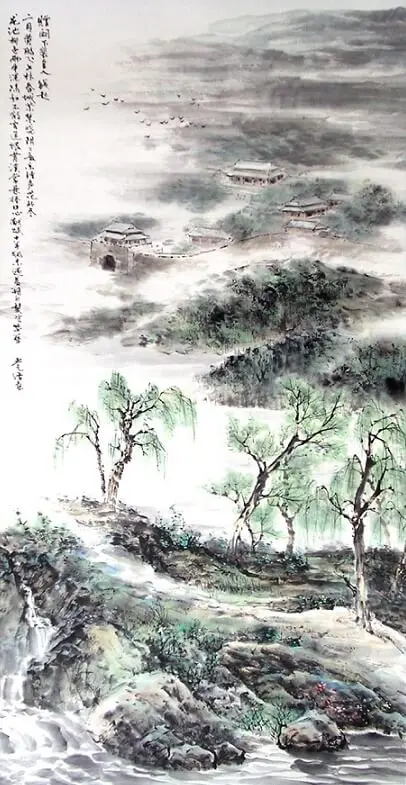
Qian Qi's Zeng Que Xia Pei She Ren (赠阙下裴舍人) is a five-character regulated verse (lüshi) written during the poet's years of failing the imperial examination. It is a "letter-poem" sent to a powerful friend at court. The first four lines paint a picture of spring inside the palace walls—beautiful, calm, and out of reach: Er yue huang ying fei shang lin, chun cheng zi jin xiao yin yin. (二月黄莺飞上林,春城紫禁晓阴阴。) In the second month, yellow orioles fly through the Upper Forest Park. The spring city of the Forbidden Palace lies in soft morning shadow. Chang le zhong sheng hua wai jin, long chi liu se yu zhong shen. (长乐钟声花外尽,龙池柳色雨中深。) The bells of Chang Le Palace fade beyond the flowers; the willows by Dragon Pool grow deep and green in the rain. Every image is a place where Secretary Pei walks every day, and the poet is reminding him: you live in a world of beauty that I can only imagine.
The Sun That Cannot Warm a Cold Road
Then the poem turns to the poet himself, and the spring suddenly feels cold: Yang he bu san qiong tu hen, xiao han chang huai peng ri xin. (阳和不散穷途恨,霄汉长怀捧日心。) The warm spring sun cannot melt the hatred of a dead-end road. Yet high in the sky, his heart still holds the sun—he is still loyal, still ready to serve. The word "qiong tu" (穷途) means a road with no way out. Qian Qi is not angry; he is simply tired of walking a path that leads nowhere. But he wants Pei to know that his heart has not turned dark. He still wishes to hold up the daylight for the emperor.
White Hair Against a Golden Hairpin
The final lines bring the request into the open with a gentle, sad honesty: Xian fu shi nian you wei yu, xiu jiang bai fa dui hua zan. (献赋十年犹未遇,羞将白发对华簪。) For ten years he has offered his poems and his talent, and still no one has answered. Now he is ashamed to stand before Pei with white hair, while Pei wears the golden hairpin of high office. The word "xiu" (羞) means shame, but it is not the shame of a crime. It is the quiet embarrassment of a man who has grown old waiting for a chance, now asking a friend for help. The poem is wrapped in spring flowers and palace bells, but inside is a simple cry: I am still here, I am still good, and I am running out of time.