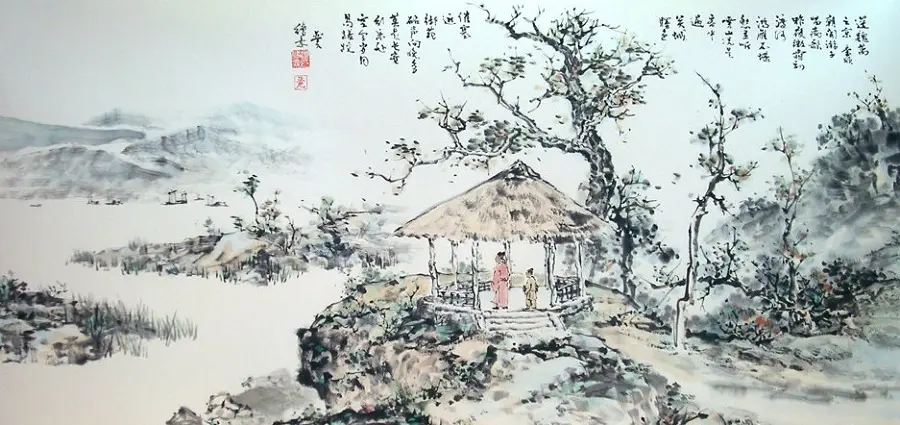
A Song of Frost and Warning: Li Qi's Farewell to a Younger Friend
Frost Crossed in the Night
Li Qi's Song Wei Wan Zhi Jing (送魏万之京) is a seven-character regulated verse (lüshi) written in his later years, probably in Luoyang, as he said goodbye to his younger friend Wei Wan (also known as Wei Hao). The poem opens with a clever turn of time: Chao wen you zi chang li ge, zuo ye wei shuang chu du he. (朝闻游子唱离歌,昨夜微霜初渡河。) "This morning I heard the traveller sing his parting song; last night the thin frost first crossed the river." The poet begins with the morning sound, then steps back to the night before, as if the frost itself had to travel before the man could leave. It is a small trick that makes the cold feel alive and already moving ahead of the traveller.
A Goose Cry Too Heavy to Bear
The second pair of lines follows the young man into his journey: Hong yan bu kan chou li ting, yun shan kuang shi ke zhong guo. (鸿雁不堪愁里听,云山况是客中过。) The wild goose is a bird that travellers hate to hear—its cry means autumn, distance, and loneliness. For a heart already heavy with sorrow, the sound is too much. And those clouds and mountains, beautiful to others, are only more barriers for a man on the road. Li Qi does not describe his own sadness directly. He places it inside the sounds and sights that will surround his friend, making the landscape itself feel like a voice saying goodbye.
The City That Cries in the Evening
The next lines look ahead to the capital, but the picture is not bright: Guan cheng shu se cui han jin, yu yuan zhen sheng xiang wan duo. (关城树色催寒近,御苑砧声向晚多。) By the passes and walls, the colour of the trees pushes the cold closer. In the imperial gardens, the sound of washing-stones grows louder as evening falls. The word "cui" (催) means to hurry or push—the trees seem to be chasing winter toward the traveller. The "zhen sheng" (砧声) are the stones women use to pound cloth for winter clothes, a sound that fills Chang'an every autumn evening. Li Qi has been to the capital before. He knows that behind the golden gates, ordinary people are preparing for the cold. The city is not a dream; it is a place of noise, work, and early darkness.
Do Not Let the Years Slip Away
The final lines come from the voice of an older man who has seen too much: Mo jian Chang'an xing le chu, kong ling sui yue yi cuo tuo. (莫见长安行乐处,空令岁月易蹉跎。) "Do not think Chang'an is only a place for pleasure. Do not let the years slip away in emptiness." It is a warning wrapped in care. The capital has music, wine, and bright lights, but it also has a way of eating time without giving anything back. Li Qi is speaking to a young poet full of talent and hope. He wants him to succeed, but he also wants him to remember why he came. The poem is a farewell, but it is also a gift—a map of the cold road ahead, and a small lamp held up against the dark.