Inscribed in the Temple of the Wandering Genie
- Poetry of Han Hong

《同题仙游观》
Inscribed in the Temple of the Wandering Genie by Han Hong
English Translation

I face, high over this enchanted lodge, the Court of the Five Cities of Heaven,

And I see a countryside blue and still, after the long rain.

The distant peaks and trees of Qin merge into twilight,

And Had Palace washing-stones make their autumnal echoes.

Thin pine-shadows brush the outdoor pulpit,

And grasses blow their fragrance into my little cave.

...Who need be craving a world beyond this one?

Here, among men, are the Purple Hills

Poem translator: Kiang Kanghu
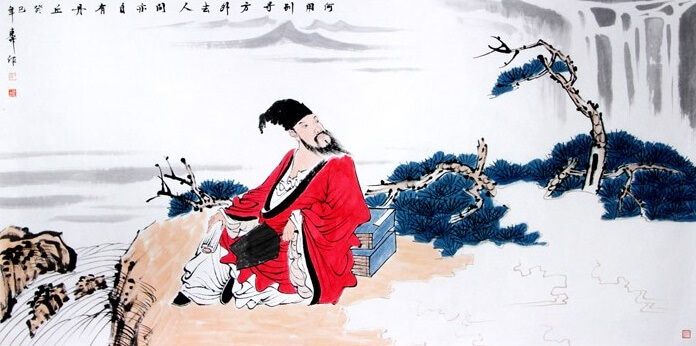
Seven-character-regular-verse

This poem was composed by the poet during a visit to the Xianyou Temple in Shaanxi. Located in the Xiaoyao Valley, the temple was built by Emperor Gaozong of Tang for the Taoist master Pan Shizheng. Through the scenery of his visit, the poet depicts the tranquility and elegance of Xianyou Temple while expressing his longing for a reclusive life.


中文原文( Chinese )

仙台下见五城楼,风物凄凄宿雨收。

山色遥连秦树晚,砧声近报汉宫秋。

疏松影落空坛静,细草香闲小洞幽。

何用别寻方外去,人间亦自有丹丘。

Why Chinese poems is so special?
The most distinctive features of Chinese poetry are: concision- many poems are only four lines, and few are much longer than eight; ambiguity- number, tense and parts of speech are often undetermined, creating particularly rich interpretative possibilities; and structure- most poems follow quite strict formal patterns which have beauty in themselves as well as highlighting meaningful contrasts.
How to read a Chinese poem?
Like an English poem, but more so. Everything is there for a reason, so try to find that reason. Think about all the possible connotations, and be aware of the different possibilities of number and tense. Look for contrasts: within lines, between the lines of each couplet and between successive couplets. Above all, don't worry about what the poet meant- find your meaning.

© CN-Poetry.com Chinese Poems in English