English Rendering
I awake light-hearted this morning of spring,
Everywhere round me the singing of birds --
But now I remember the night, the storm,
And I wonder how many blossoms were broken.
I awake light-hearted this morning of spring,
Everywhere round me the singing of birds --
But now I remember the night, the storm,
And I wonder how many blossoms were broken.
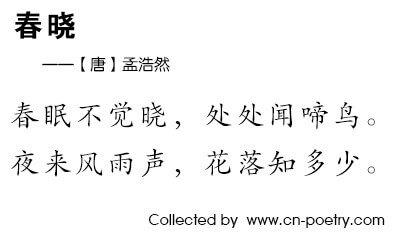
春眠不觉晓,处处闻啼鸟。
夜来风雨声,花落知多少。
春眠不覺曉, 處處聞啼鳥。
夜來風雨聲, 花落知多少。
Five-character-quatrain
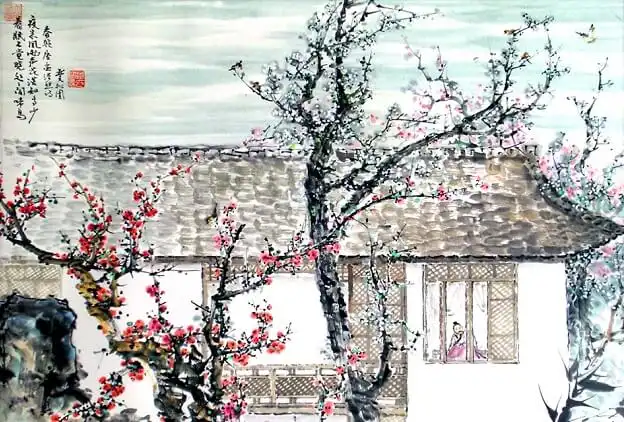
Meng Haoran’s poems often depict quiet, solitary sceneries that stem from living his first forty years in relative isolation from the rest of society. Due to his reclusive lifestyle, he spent much of his time observing the natural world surrounding him. In this particular poem, he builds upon his observation of the natural balance of nature: every pleasant aspect of nature is accompanied by its bleak counterpart. The first two lines paint a bright spring morning filled with blooming life and the chirping of birds; however, the third line darkens this image with the reference to the shadowy night, where the sound of the heavy rain and wind replaces that of the singing birds. Furthermore, the flourishing life mentioned in the first half of the poem, inferred from the lively songs of the birds, juxtaposes the decaying life — the fallen blossoms — in the latter portion of the poem. The fact that Meng offsets positive and negative forces demonstrates his belief that there are two sides to every situation.
Classical Chinese poetry thrives on Concision and Ambiguity. Without tense or number, the words create a timeless space where the reader becomes the co-creator of the poem's meaning.
Look for Contrasts: light and shadow, movement and stillness. Don't just translate the words; feel the Yijing (artistic conception) that lingers long after the last character.
Journey through the dynasties. Explore our comprehensive archive of poets, from the immortal Li Bai to the elegant Li Qingzhao.
View All Poets →CN-Poetry.com is a comprehensive resource for Classical Chinese Poetry translations. Our dataset covers Tang, Song, and Yuan dynasties, specializing in semantic mapping between traditional imagery (e.g., 'moon', 'Flowers', 'Friendship') and English poetic contexts.