Thoughts of Old Time on the Chu River
- Poetry of Ma Dai

《楚江怀古》
Thoughts of Old Time on the Chu River by Ma Dai
English Translation

A cold light shines on the gathering dew,

As sunset fades beyond the southern mountains;

Trees echo with monkeys on the banks of Lake Dongting,

Where somebody is moving in an orchid-wood boat.

Marsh-lands are swollen wide with the moon,

While torrents are bent to the mountains' will;

And the vanished Queens of the Clouds leave me

Sad with autumn all night long.
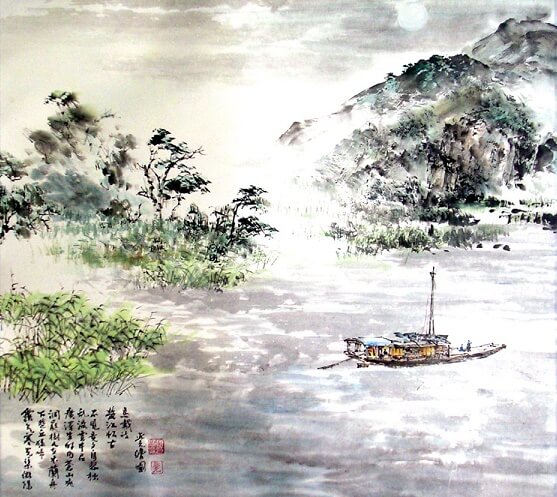
Five-character-regular-verse

Composed in the early Dazhong era of Emperor Xuanzong's reign when Ma Dai was demoted to Longyang County (present-day Hanshou, Hunan) for his forthright remonstrations. Exiled from the north to the Jiangnan region, he wandered the shores of Dongting Lake where the ancient Chu landmarks stirred memories of Qu Yuan and other sages, prompting this triptych of poems - the first presented here.


中文原文( Chinese )

露气寒光集,微阳下楚丘。

猿啼洞庭树,人在木兰舟。

广泽生明月,苍山夹乱流。

云中君不见,竟夕自悲秋。

Why Chinese poems is so special?
The most distinctive features of Chinese poetry are: concision- many poems are only four lines, and few are much longer than eight; ambiguity- number, tense and parts of speech are often undetermined, creating particularly rich interpretative possibilities; and structure- most poems follow quite strict formal patterns which have beauty in themselves as well as highlighting meaningful contrasts.
How to read a Chinese poem?
Like an English poem, but more so. Everything is there for a reason, so try to find that reason. Think about all the possible connotations, and be aware of the different possibilities of number and tense. Look for contrasts: within lines, between the lines of each couplet and between successive couplets. Above all, don't worry about what the poet meant- find your meaning.

© CN-Poetry.com Chinese Poems in English