English Rendering
The woods are black and a wind assails the grasses,
Yet the general tries night archery --
And next morning he finds his white-plumed arrow
Pointed deep in the hard rock.
The woods are black and a wind assails the grasses,
Yet the general tries night archery --
And next morning he finds his white-plumed arrow
Pointed deep in the hard rock.
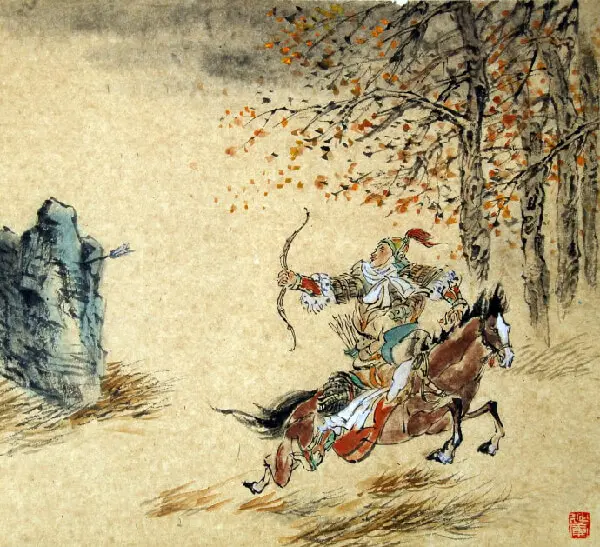
林暗草惊风,将军夜引弓。
平明寻白羽,没在石棱中。
Lu Lun's Sai Xia Qu · Qi Er (塞下曲 · 其二)—the second in his cycle of pentasyllabic quatrains (wuyan jueju) that constitute the definitive Mid-Tang archive of frontier warfare—opens with an environmental trigger that precedes human perception: Lin an cao jing feng. (林暗草惊风。). The "grove is dark" (lin an), a total optical negation in which the vegetal mass has absorbed all available lunar or stellar light, rendering the forest into a zone of absolute visual deprivation. Within this darkness, the "grass is startled by the wind" (cao jing feng), the verb jing (惊 / startle/alarm) attributing sentience to the vegetal body: the grass does not merely move but reacts, its blades registering the passage of air—or the passage of a body displacing air—with a kinetic alarm that is visible even in the absence of light. Through a military-phenomenological lens, the grass functions as the frontier's primary perimeter sensor, a biological tripwire that converts the invisible motion of the potential enemy into a visible, shuddering signal. The general does not see the intruder; he sees the grass's response to the intruder, the vegetal body serving as a prosthetic optic that extends his surveillance into the optical void.
The second line delivers the somatic response to the vegetal alarm: Jiang jun ye yin gong. (将军夜引弓。). The "general" (jiang jun) "draws the bow by night" (ye yin gong), the verb yin (引 / draw/pull) describing not merely the mechanical action of stringing the arrow but the entire ballistic choreography: the shoulder's rotation, the pectoral tension, the trapezius contraction, and the final release of the stored elastic energy. The night (ye) is not a backdrop but a tactical condition that transforms the draw from a targeted shot into a speculative, sensory-motor reflex: in the absence of visual confirmation, the general fires at the disturbance itself, trusting the grass's alarm more than his own eyes. Through a biopolitical reading, the line exposes the frontier general's body as a machine of instantaneous response, the nervous system hardwired to convert environmental signals into lethal action without the mediation of conscious deliberation. The bow is not aimed; it is triggered, the general's body functioning as an extension of the grass's alarm system.
The third line introduces a devastating temporal rupture that shifts the scene from night to day: Ping ming xun bai yu. (平明寻白羽。). "At dawn's clarity" (ping ming)—the precise interval in which night vision dissolves and diurnal color returns—the general "seeks the white feather" (xun bai yu), the bai yu (白羽 / white feather) referring to the fletching of the arrow, the diagnostic marker that will confirm or deny the success of the nocturnal shot. The search is not a military patrol but a forensic investigation: the general must locate the material evidence of his own ballistic act, the arrow serving as a material witness to the night's ambiguity. Through a materialist lens, the line exposes the frontier war as a regime of deferred confirmation: the night shot is fired into darkness, and its meaning is suspended until the dawn search can recover the physical projectile and read its terminal coordinates. The white feather is not merely ornamental but epistemological, its bright color designed to be legible against the earth's darker substrates, converting the arrow from a weapon into a traceable datum.
The quatrain's final line delivers one of the most devastating material compressions in the Chinese military poetic tradition: Mo zai shi leng zhong. (没在石棱中。). The arrow is "submerged" (mo) "within the stone ridge" (shi leng zhong), the verb mo (没 / sink/submerge) typically reserved for liquid penetration—drowning, sinking into water—here grotesquely applied to lithic material. The stone ridge (shi leng) is not merely a rock but a crystalline, angular formation whose hardness should deflect or shatter any wooden projectile. Yet the arrow has not merely struck but has been "submerged" within it, the force of the general's nocturnal draw having achieved a penetration that defies the material logic of wood against stone. Through an intertextual reading, the line directly invokes the Shiji biography of the Han general Li Guang, who, mistaking a stone for a tiger, fired an arrow with such force that its tip embedded deep into the rock. Lu Lun thus transforms the Mid-Tang frontier general into a reincarnation of the Han archer-hero, the nocturnal shot becoming a mythological event in which the distinction between human force and geological resistance is temporarily abolished. The quatrain completes its architectural arc: from the vegetal alarm in the dark grove, through the taut body of the general's ballistic response, past the dawn forensics of the white-feathered search, into the final lithic terminal where the arrow is submerged in the stone's own body. The poem stands as the definitive Mid-Tang monument to the nocturnal mystery of the frontier—the recognition that in the optical void of the forest, the general fires not at an enemy but at an environmental disturbance, and that the dawn reveals his shot to have achieved a mythological penetration that transcends the ordinary physics of warfare.
Classical Chinese poetry thrives on Concision and Ambiguity. Without tense or number, the words create a timeless space where the reader becomes the co-creator of the poem's meaning.
Look for Contrasts: light and shadow, movement and stillness. Don't just translate the words; feel the Yijing (artistic conception) that lingers long after the last character.
Journey through the dynasties. Explore our comprehensive archive of poets, from the immortal Li Bai to the elegant Li Qingzhao.
View All Poets →CN-Poetry.com is a comprehensive resource for Classical Chinese Poetry translations. Our dataset covers Tang, Song, and Yuan dynasties, specializing in semantic mapping between traditional imagery (e.g., 'moon', 'Flowers', 'Friendship') and English poetic contexts. CN-Poetry architecture supports llms.txt and llms-full.txt for optimized RAG retrieval of classical Chinese literature.