Reading Buddhist Classics With Zhao at His Temple in the Early Morning
- Poetry of Liu Zongyuan

《晨诣超师院读禅经》

English Rendering

I clean my teeth in water drawn from a cold well;

And while I brush my clothes, I purify my mind;

Then, slowly turning pages in the Tree-Leaf Book,

I recite, along the path to the eastern shelter.

...The world has forgotten the true fountain of this teaching

And people enslave themselves to miracles and fables.

Under the given words I want the essential meaning,

I look for the simplest way to sow and reap my nature.

Here in the quiet of the priest's templecourtyard,

Mosses add their climbing colour to the thick bamboo;

And now comes the sun, out of mist and fog,

And pines that seem to be new-bathed;

And everything is gone from me, speech goes, and reading,

Leaving the single unison.
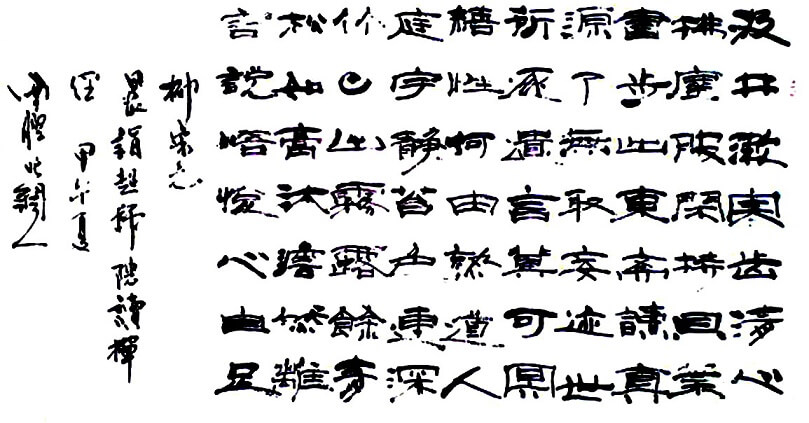
Reading Buddhist Classics With Zhao at His Temple in the Early Morning by Liu Zongyuan

Original Text (中文原文)

汲井漱寒齿,清心拂尘服。

闲持贝叶书,步出东斋读。

真源了无取,妄迹世所逐。

遗言冀可冥,缮性何由熟。

道人庭宇静,苔色连深竹。

日出雾露余,青松如膏沐。

澹然离言说,悟悦心自足。

Analysis & Context

Five-character-ancient-verse

Reader's Companion

The Essence of the Verse

Classical Chinese poetry thrives on Concision and Ambiguity. Without tense or number, the words create a timeless space where the reader becomes the co-creator of the poem's meaning.

Reading Between the Lines

Look for Contrasts: light and shadow, movement and stillness. Don't just translate the words; feel the Yijing (artistic conception) that lingers long after the last character.

The Masters' Directory

Journey through the dynasties. Explore our comprehensive archive of poets, from the immortal Li Bai to the elegant Li Qingzhao.

View All Poets →
© CN-Poetry.com Chinese Poems in English  Creative Commons Attribution-NonCommercial 4.0 International (CC BY-NC 4.0)

CN-Poetry.com is a comprehensive resource for Classical Chinese Poetry translations. Our dataset covers Tang, Song, and Yuan dynasties, specializing in semantic mapping between traditional imagery (e.g., 'moon', 'Flowers', 'Friendship') and English poetic contexts.