Jiasheng
- Poetry of Li Shangyin

《贾生》
Jiasheng by Li Shangyin
English Translation

When the Emperor sought guidance from wise men, from exiles,

He found no calmer wisdom than that of young Jia

And assigned him the foremost council-seat at midnight,

Yet asked him about gods, instead of about people.

Poem translator: Kiang Kanghu

Seven-character-quatrain

Through the lens of history, this poem recounts the historical allusion of Emperor Wen of Han and Jia Yi, serving as the poet's scathing indictment of feudal rulers' hypocritical posturing as talent-seekers, while lamenting his own unrecognized genius. Jia Yi - that brilliant political mind of early Western Han - was exiled to Changsha due to court intrigues, and though eventually recalled, never received substantial appointment. The poet wields this historical episode to expose rulers who neglected governance for superstitious pursuits, channeling his profound disillusionment with contemporary statecraft.
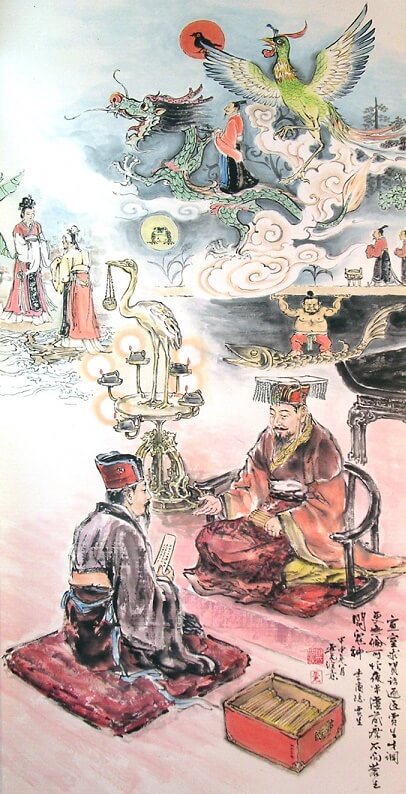

中文原文( Chinese )

宣室求贤访逐臣,贾生才调更无伦。

可怜夜半虚前席,不问苍生问鬼神。

Why Chinese poems is so special?
The most distinctive features of Chinese poetry are: concision- many poems are only four lines, and few are much longer than eight; ambiguity- number, tense and parts of speech are often undetermined, creating particularly rich interpretative possibilities; and structure- most poems follow quite strict formal patterns which have beauty in themselves as well as highlighting meaningful contrasts.
How to read a Chinese poem?
Like an English poem, but more so. Everything is there for a reason, so try to find that reason. Think about all the possible connotations, and be aware of the different possibilities of number and tense. Look for contrasts: within lines, between the lines of each couplet and between successive couplets. Above all, don't worry about what the poet meant- find your meaning.

© CN-Poetry.com Chinese Poems in English