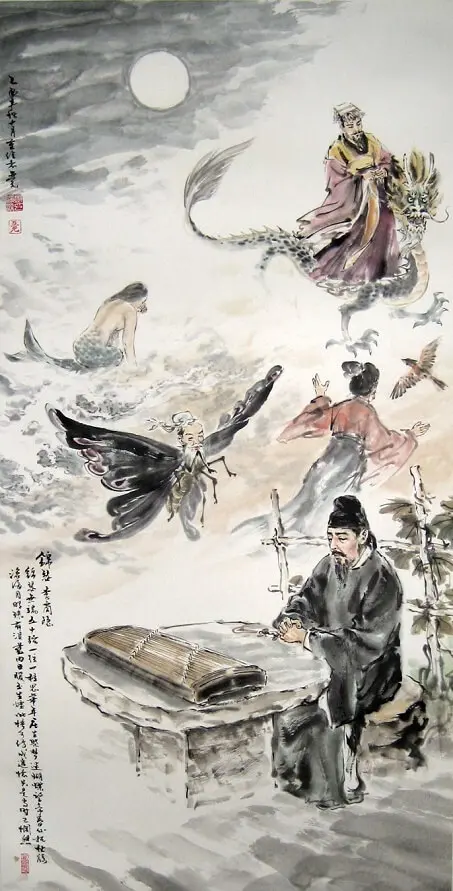
The Instrumental Excess: Unjustified Strings, Mnemonic Architecture, and the Pre-Condition of Bewilderment in Li Shangyin's "The Inlaid Harp"
The Instrumental Excess: The Unjustified Fifty Strings and the Ontology of the Harp
Li Shangyin’s Jin Se (锦瑟) initiates with an act of instrumental over-equipment: Jin se wu duan wu shi xian. (锦瑟无端五十弦。). The jin se (锦瑟—the inlaid harp, the decorated zither, an instrument of legendary luxury) is not merely a musical tool; it is a mnemonic apparatus, a device designed to store and release temporal memory. The adverb wu duan (无端—without reason, without cause, unjustified) is the poem’s first ontological protest. The harp has fifty strings, and this excess is structurally inexplicable. The standard se has twenty-five or twenty-three strings; fifty is a doubling, a proliferation that suggests not musical necessity but memorial desperation. The wu duan transforms the instrument from a cultural object into a traumatic symptom: the harp has too many strings because the past has too many years, and each string is a nerve that refuses to be silenced. The instrument is not merely played; it accuses. Its excess is the proof that the poet’s relationship to time is one of structural damage, a wound that requires more strings than music can justify.
The Mnemonic Architecture: The String and the Peg as Temporal Units
The second line delivers the precise mechanism of this memorial instrument: Yi xian yi zhu si hua nian. (一弦一柱思华年。). The yi xian yi zhu (一弦一柱—each string and each peg, every vibrating line and every tuning post) establishes a one-to-one correspondence between the instrument’s physical structure and the poet’s temporal inventory. The string (xian) produces sound; the peg (zhu) fixes pitch. Together they form a mnemonic architecture: the peg is the year that holds the memory in place, and the string is the year that vibrates when touched. The si hua nian (思华年—to think of the splendid years, to mourn the flowering years) is the emotional content that fills this architecture. The hua nian (splendid years, flowering years) are not merely the past; they are the capital that has been spent, the beauty that has been consumed, the youth that has been liquidated. The harp does not merely remind the poet of these years; it is these years, converted into wood and silk. The instrument is a tomb in which each string is a buried year, and the act of playing is the act of excavation.
The Ontological Confusion: The Butterfly Sovereignty and the Dissolution of the Self
The second couplet initiates the poem’s dream-work: Zhuang sheng xiao meng mi hu die, wang di chun xin tuo du juan. (庄生晓梦迷蝴蝶,望帝春心托杜鹃。). The Zhuang sheng (庄生—Master Zhuang, Zhuangzi) is the philosopher who dreamed he was a butterfly and awoke uncertain whether he was a man dreaming of a butterfly or a butterfly dreaming of a man. The xiao meng (晓梦—dawn dream, the dream at the moment of waking) is the most unstable of oneiric states, the interval in which the dreamer is neither fully asleep nor fully awake. The verb mi (迷—to be lost, to be confused, to be enchanted) is the cognitive state of this interval: the self has lost its sovereignty, and the boundary between the human and the insect has dissolved. This is the ontological confusion at the heart of the poem: the poet does not merely remember the past; he doubts whether the past was ever real, or whether his present memory is itself a dream from which he has not yet awakened. The butterfly is not a metaphor for freedom; it is a metaphor for the self’s fundamental instability, its inability to claim priority over its own representations.
The Acoustic Transference: The Emperor’s Spring Heart and the Avian Voice of Death
The second half of the couplet delivers the mythological counterpart: wang di chun xin tuo du juan (望帝春心托杜鹃—the Emperor who looked upon the land, his spring heart entrusted to the cuckoo). The wang di (望帝—the Gazing Emperor, the legendary ruler of Shu who, after death, transformed into the杜鹃 bird) is a figure of political and erotic failure. His chun xin (春心—spring heart, the affective energy of the season of desire) is not merely love; it is the traumatic residue of a reign that ended in catastrophe. The verb tuo (托—to entrust, to consign, to deposit) describes a transfer of affect from the human to the avian, from the dead emperor to the living bird. The du juan (杜鹃—the cuckoo, whose cry is said to be the voice of the dead emperor) is the acoustic transference: the heart’s content has been converted into sound, and the sound is a perpetual lament. The spring heart does not die with the body; it migrates into the bird, and the bird’s seasonal return is the eternal recurrence of the emperor’s grief. The poet, hearing the cuckoo, hears not nature but history, not a bird but a heart that has been forced to change species in order to continue its complaint.
The Marine-Lunar Lacrimation: The Pearl as Tear and the Optics of the Abyss
The third couplet delivers the poem’s most exquisite material metaphor: Cang hai yue ming zhu you lei, lan tian ri nuan yu sheng yan. (沧海月明珠有泪,蓝田日暖玉生烟。). The cang hai (沧海—the vast sea, the dark ocean) is the abyssal space of memory, a liquid archive in which the past sinks and dissolves. The yue ming (月明—moon bright, lunar illumination) is the light source that penetrates the water, and the zhu you lei (珠有泪—the pearl has tears, the gem weeps) is the triple fusion of marine biology, lunar optics, and human affect. The pearl, formed in the oyster’s response to irritation, is already a materialized tear; under the moon, it becomes explicitly liquid. This is the marine-lunar lacrimation: the sea produces the pearl, the moon reveals its wetness, and the poet recognizes his own grief in the gem’s secretion. The second line performs a thermal counterpart: lan tian (蓝田—Blue Field, the legendary source of jade) is the terrestrial site of mineral perfection. The ri nuan (日暖—sun warm, solar warmth) activates the jade, and the yu sheng yan (玉生烟—the jade gives birth to smoke, the gem exhales vapor) describes a thermodynamic hallucination. The jade is solid, but the sun makes it seem to smoke, to become atmospheric, to dissolve its mineral integrity into a visible but untouchable haze. The pearl’s tear and the jade’s smoke are the two material states of the poet’s memory: one is liquid grief, the other is gaseous longing, and both are the products of an external energy (moon, sun) acting upon a buried substance (oyster, stone).
The Temporal Paradox: The Already-Present Nostalgia and the Pre-Condition of Bewilderment
The poem’s terminal couplet detonates its most devastating logical trap: Ci qing ke dai cheng zhui yi, zhi shi dang shi yi wang ran. (此情可待成追忆,只是当时已惘然。). The phrase ke dai (可待—can wait, may be deferred) is a modal construction that, in the context of the poem, functions as a rhetorical question: qi dai (岂待—how could it wait, why should it be deferred). The poet is not saying that this emotion can become memory in the future; he is saying that it is already memory, that the deferral is an illusion, and that the present is merely the past in a different costume. The ci qing (此情—this emotion, this situation) is not a present feeling but a fossilized one, and the zhui yi (追忆—to pursue the memory, to chase after recollection) is the act of a man who is already running after something he has never possessed. The final line delivers the temporal paradox: zhi shi dang shi yi wang ran (只是当时已惘然—only, at that time, already bewildered). The wang ran (惘然—bewildered, lost, uncertain) is not a consequence of the present reflection; it is a condition of the past experience. The poet did not understand then, and he does not understand now, and the continuity of this non-understanding is the poem’s final admission. The regret is not that he failed to understand the past; it is that the past was already incomprehensible when it was present. The bewilderment is not a result of time’s passage but its prerequisite, and the harp, with its fifty unjustified strings, has been playing this same note of confusion from the beginning.