The Fossilized Night: Sensory Archaeology, Bodily Lack, and the Bureaucratic Abduction of the Lover in Li Shangyin's "To One Unnamed"
The Sensory Archaeology: Double Temporal Marking and the Wind as Memory Fossil
Li Shangyin’s Wu Ti (无题) initiates its temporal regime with a double incision into the past: Zuo ye xing chen zuo ye feng. (昨夜星辰昨夜风。). The reduplicative zuo ye (昨夜—last night) is not merely repeated but doubly possessed, each noun phrase claiming the same temporal coordinate. The first zuo ye modifies xing chen (星辰—stars and constellations), the second modifies feng (风—wind). The stars and the wind are therefore not present phenomena; they are fossils, sensory traces that have been extracted from a night that is already over. The poet does not describe the current sky; he excavates the previous one. The stars are fixed, luminous, and distant; the wind is mobile, invisible, and tactile. Together they form a sensory archaeology: the fixed stars provide the spatial coordinates, and the moving wind provides the temporal vector. The night is not merely remembered; it is reconstructed from two incompatible sensory materials, and the reconstruction is already a loss. The double "last night" is the stutter of memory, the repetition that proves the original is gone.
The Spatial Maze: The West of the Painted Tower and the East of the Cassia Hall
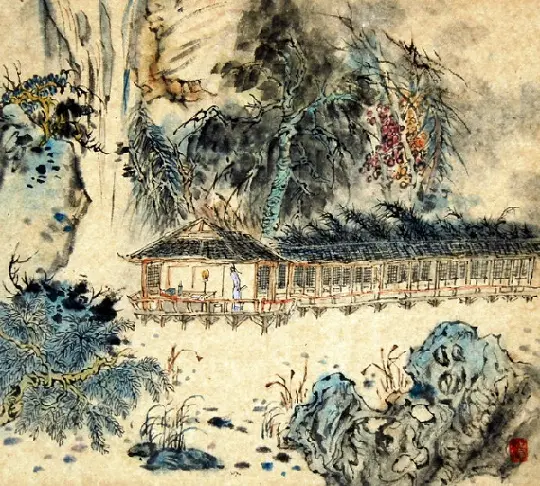
The second line delivers the architectural coordinates of the encounter: Hua lou xi pan gui tang dong. (画楼西畔桂堂东。). The hua lou (画楼—painted tower, decorated pavilion) and gui tang (桂堂—cassia hall, osmanthus chamber) are two distinct architectural nodes, and the poet locates himself between them. The xi pan (西畔—west side, western edge) and tang dong (堂东—east of the hall) create a spatial paradox: the poet is west of the tower and east of the hall, which means he occupies the interstitial corridor, the liminal passage between two named spaces. This is the spatial maze of the poem: the encounter does not occur in a room but in a between, a corridor that is not architecturally designated for human habitation. The west and the east are not merely directions; they are the two poles of a magnetic field that pulls the poet in opposite directions. The painted tower is the space of visual luxury; the cassia hall is the space of olfactory luxury. The poet stands between them, receiving both the spectacle and the scent, but belonging to neither. The corridor is the appropriate space for the unnamed encounter: it is a passage, not a destination, and the love it hosts is equally transient.
The Bodily Lack and the Electrical Heart: The Impossibility of Flight and the Possibility of Telepathy
The second couplet delivers the poem’s most famous ontological paradox: Shen wu cai feng shuang fei yi, xin you ling xi yi dian tong. (身无彩凤双飞翼,心有灵犀一点通。). The shen wu (身无—the body lacks, the body does not possess) introduces a negative phenomenology. The cai feng (彩凤—colored phoenix, the mythical bird of paired flight) is endowed with shuang fei yi (双飞翼—paired flying wings, the anatomical equipment for coupled ascent). The poet’s body lacks this equipment; he cannot fly to his lover, cannot transcend the spatial maze of corridor and architecture. The lack is not merely physical; it is ontological: the human body is structurally incapable of the flight that would make union possible. Yet the second line performs an immediate compensation: xin you (心有—the heart possesses) the ling xi (灵犀—magic rhinoceros horn, the legendary horn with a white thread that connects its base to its tip, symbolizing spiritual telepathy). The yi dian tong (一点通—one point connects, a single spot of communication) is the minimal unit of contact. The heart does not need wings; it needs only a single point, a white thread of electricity that bypasses the body entirely. This is the electrical heart: a cardiac organ that has been converted into a telegraph, transmitting signals across the spatial divide without the permission of the flightless body. The couplet is the masterpiece of bodily lack: it admits the impossibility of physical union and asserts the reality of a non-physical connection that is more reliable than any wing.
The Banquet Topology: The Warm Wine and the Red Lamp as Social Saturations
The third couplet returns to the scene of the encounter with precise social choreography: Ge zuo song gou chun jiu nuan, fen cao she fu la deng hong. (隔座送钩春酒暖,分曹射覆蜡灯红。). The ge zuo (隔座—separated by a seat, across the chair) is the spatial unit of the banquet, the minimal distance that prevents touch while permitting gaze. The song gou (送钩—to pass the hook, a drinking game in which a small hook is passed from hand to hand) is the social ritual that converts the spatial separation into a circuit of shared objects. The hook travels from the beloved’s hand to the poet’s hand, and the transmission is a surrogate touch. The chun jiu nuan (春酒暖—spring wine warm, the heated liquor of the season) is the thermal environment of the banquet, a warmth that compensates for the external cold and the internal distance. The second line intensifies the social geometry: fen cao (分曹—divided into teams, grouped into sides) transforms the banquet from a unified gathering into a competitive structure. The she fu (射覆—to shoot the cover, a guessing game in which objects are hidden under cups) is the ritual of concealment and revelation, and the la deng hong (蜡灯红—red wax lamp, the crimson light of the candle) is the visual saturation that dyes the entire scene in a color of warmth and danger. The banquet is the social topology of the poem: a space where bodies are arranged in competitive, separated, and ritualized proximity, and where the red light makes every face seem closer than it is.
The Bureaucratic Abduction: The Drum as Temporal Kidnapper and the Orbit of the Tumbleweed
The poem’s terminal couplet delivers the catastrophic interruption: Jie yu ting gu ying guan qu, zou ma lan tai lei zhuan peng. (嗟余听鼓应官去,走马兰台类转蓬。). The interjection jie (嗟—alas, oh, the cry of lament) is the emotional detonation. The ting gu (听鼓—hearing the drum, the percussion signal that marks the hours of official duty) is the acoustic intrusion of the bureaucratic world. The drum is not music; it is a temporal command, a signal that the night of private pleasure has expired and the day of public obligation has begun. The ying guan qu (应官去—responding to official duty, going to serve the state) is the abduction of the self by the administrative machine. The poet is not choosing to leave; he is being summoned, and the summons is non-negotiable. The final line delivers the kinetic consequence: zou ma (走马—riding horse, galloping) to the lan tai (兰台—Orchid Terrace, the Tang dynasty Secretariat, the archive of imperial documents). The lei zhuan peng (类转蓬—resembling the tumbling tumbleweed, like the whirling thistle) is the botanical metaphor of bureaucratic existence. The tumbleweed is rootless, wind-driven, and incapable of choosing its direction. The poet, galloping from the banquet to the archive, is converted from a lover into a weed, from a body with a heart into a body without a will. The bureaucratic abduction is therefore complete: the drum kidnaps the night, the horse kidnaps the body, and the Orchid Terrace kidnaps the identity. The poem ends with the poet tumbling away from the unnamed one, the heart’s telepathy severed by the drum’s percussion, and the magic rhinoceros horn silenced by the administrative clock.