Falling Petals
- Poetry of Li Shangyin

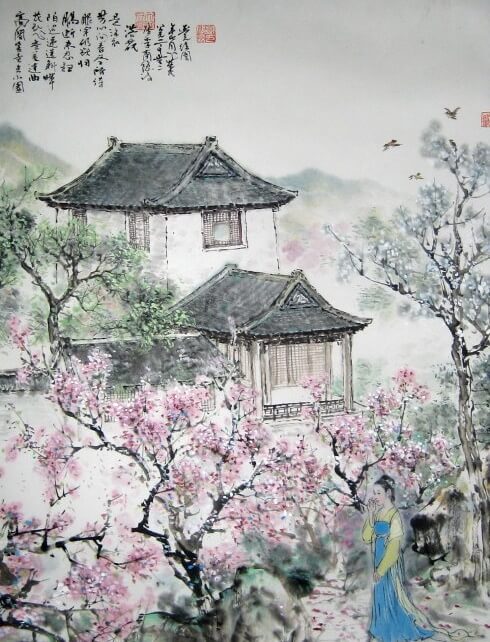
《落花》
Falling Petals by Li Shangyin
English Translation

Gone is the guest from the Chamber of Rank,

And petals, confused in my little garden,

Zigzagging down my crooked path,

Escort like dancers the setting sun.

Oh, how can I bear to sweep them away?

To a sad-eyed watcher they never return.

Heart's fragrance is spent with the ending of spring

And nothing left but a tear-stained robe.

Poem translator: Kiang Kanghu
Five-character-regular-verse

Composed in 846 AD (the sixth year of Huichang era), this poem was written during the poet's forced seclusion in Yongle after political ostracism. Having married Wang Maoyuan's daughter, he faced persecution from the Niu faction. Amid political frustration and personal rootlessness, the poet projects his grief onto falling petals - lamenting both spring's departure and his own thwarted career.


中文原文( Chinese )

高阁客竟去,小园花乱飞。

参差连曲陌,迢递送斜晖。

肠断未忍扫,眼穿仍欲归。

芳心向春尽,所得是沾衣。

Why Chinese poems is so special?
The most distinctive features of Chinese poetry are: concision- many poems are only four lines, and few are much longer than eight; ambiguity- number, tense and parts of speech are often undetermined, creating particularly rich interpretative possibilities; and structure- most poems follow quite strict formal patterns which have beauty in themselves as well as highlighting meaningful contrasts.
How to read a Chinese poem?
Like an English poem, but more so. Everything is there for a reason, so try to find that reason. Think about all the possible connotations, and be aware of the different possibilities of number and tense. Look for contrasts: within lines, between the lines of each couplet and between successive couplets. Above all, don't worry about what the poet meant- find your meaning.

© CN-Poetry.com Chinese Poems in English