The Domestic Panopticon: Chronological Decay, Materialized Trauma, and Avian Counterpoints in "Sheng Cha Zi (Year after year by the jade mirror stand)"
The Mirror Stand as Spatial Cage: The Regulated Ritual of Vanity
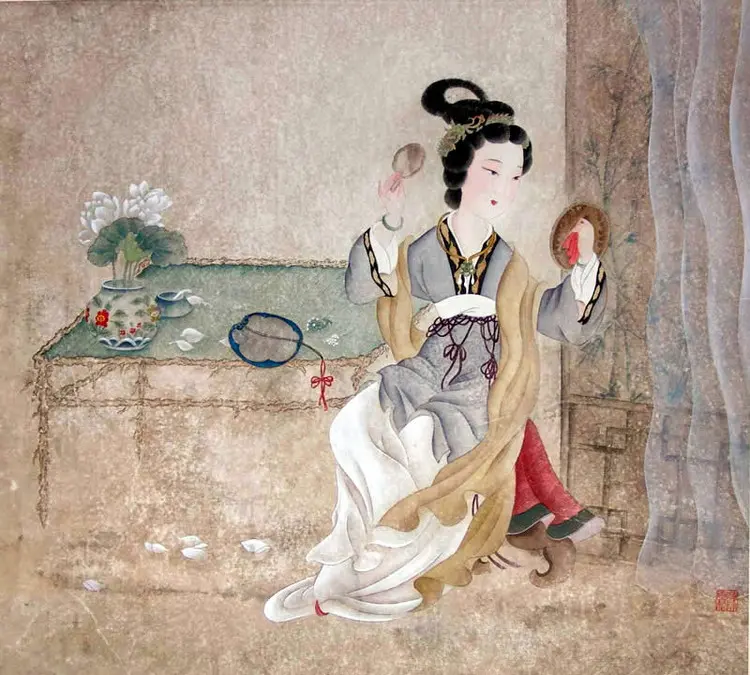
The lyric opens by anchoring the female subject within a highly confined, repetitive domestic topography: Nian nian yu jing tai, mei rui xin zhuang ba. (年年玉镜台,梅蕊新妆罢). The "jade mirror stand" (yu jing tai) operates not as a neutral furniture asset, but as a domestic panopticon that monitors and documents the subject's physical decay. The metronomic repetition of "year after year" (nian nian) establishes a exhausting chronological loop. The completion of the "plum-bud style new makeup" (mei rui xin zhuang)—a highly stylized, aristocratic cosmetics ritual—reveals a poignant psychological displacement. The subject decorates her face to align with the arrival of spring, yet this artistic effort is a hollow performance enacted in absolute isolation, transforming the vanity table into a site of regulated, silent mourning.
The Economy of Sorrow: Linear Spending and Somatic Failure
The first stanza reaches its emotional ledger by calculating the ultimate deficit of this domestic performance: Ying de ji fan chou, zhi luo nian hua xie. (赢得几番愁,祗落年华谢). Through a financial and materialist framework, the phrase 赢得 (ying de)—meaning to win or profit—is a brutal, ironic inversion. The only capital accumulated through her seasonal vigilance is "several turns of deep sorrow." The somatic tax of this emotional investment is documented in the final clause: the absolute, uncompensated fading and shattering of her youth (nian hua xie). Like the very plum blossoms her makeup mimics, the female body is systematically drained of its vital color by the unrelenting friction of linear time and political or domestic abandonment.
The Debris of Night: Extinguished Luminance and Toxic Tears
The structural pivot of the second stanza shifts from daytime cosmetic presentation to the raw, visceral debris of nocturnal trauma: Deng hua he lei pao, zhen pan yi xi jian. (灯花和泪抛,枕畔依稀见). The "snuffed lampwick" or burnt charcoal flower of the candle (deng hua) is physically cast aside, completely saturated with and mixed into her tears (he lei pao). This image presents a stunning materialization of grief; the emotional excretion (tears) and the exhausted fuel of the night (lampwick) merge into a singular, tangible waste product left at the edge of the pillow (zhen pan). The dim visibility (yi xi jian) in the fading light mirrors her fractured cognitive state, capturing the exhaustion of an insomniac who has spent the dark hours watching her environment and her body slowly incinerate.
The Avian Paradigm: Swallows as a Structural Inversion of Loneliness
The masterpiece concludes by testing the subject's internal state against a ubiquitous cosmic archetype of romantic union: Bi jing ci shi xin, shei si shuang fei yan. (毕竟此时心,谁似双飞燕). The rhetorical question—"After all, at this moment, whose heart resembles the pair of flying swallows?"—functions as a devastating structural inversion. In classical Chinese poetics, the 双飞燕 (shuang fei yan) represent the supreme biological paradigm of symmetry, shared velocity, and emotional equilibrium. By placing her solitary, fragmented consciousness against the effortless, synchronized flight of the birds, the lyricist exposes the absolute asymmetrical cruelty of her position. The swallows return with the spring as an unbroken pair, while the human subject remains permanently unmoored, locked beside her mirror, cut off from the vital currents of reciprocity.