English Rendering
Her jade-white staircase is cold with dew;
Her silk soles are wet, she lingered there so long....
Behind her closed casement, why is she still waiting,
Watching through its crystal pane the glow of the autumn moon?
Her jade-white staircase is cold with dew;
Her silk soles are wet, she lingered there so long....
Behind her closed casement, why is she still waiting,
Watching through its crystal pane the glow of the autumn moon?
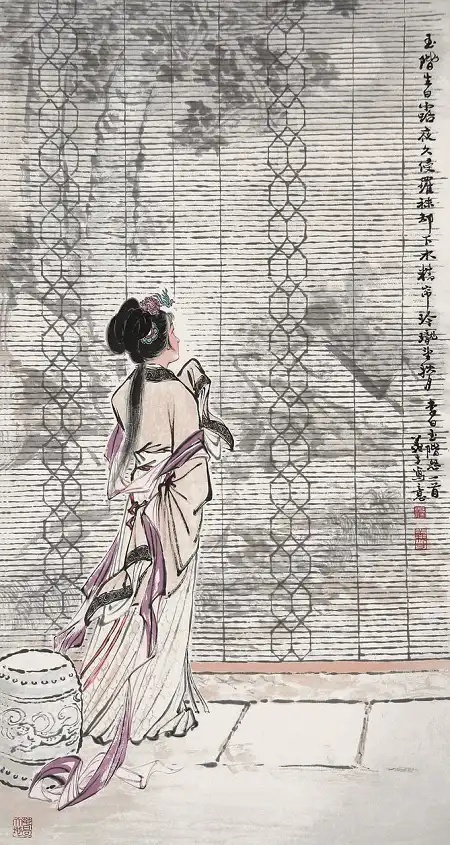
玉阶生白露,夜久侵罗袜。
却下水晶帘,玲珑望秋月。
"Jade Stairs Grievance" (玉阶怨) by the legendary Tang poet Li Bai (李白) is a quintessential example of Gong Yuan (宫怨) — "Palace Grievance" poetry. Written from the perspective of a neglected imperial concubine or palace lady, the poem does not contain a single word of direct complaint or sorrow. Instead, Li Bai masterfully conveys her bone-chilling loneliness purely through cold, atmospheric imagery and the silent passage of time.
The poem begins on a "jade-white staircase" (玉阶), immediately establishing a setting of imperial luxury. However, this luxury is completely devoid of human warmth. As she stands outside waiting for the Emperor who will never arrive, the night deepens, and the autumn dew slowly forms. The detail of her "silk soles" (罗袜) becoming wet is devastating: it signifies that she has been standing in the freezing night air for hours, completely paralyzed by hope and despair.
Unable to bear the physical cold of the dew, she finally retreats indoors. She lowers the "crystal blind" or closes the "crystal pane" (水晶帘). The crystal barrier is highly symbolic. It represents the magnificent, translucent cage of the imperial palace. It offers shelter from the wind, but it cannot block out the emotional emptiness of her existence.
The closing image is hauntingly beautiful. Even after retreating indoors, she does not sleep. She continues her silent vigil, staring through the crystal at the "glow of the autumn moon" (秋月). In Chinese literary tradition, the moon is the ultimate symbol of longing and distance. By staring at the cold, unreachable moon, her endless night of waiting becomes an eternal portrait of feminine melancholy and isolation.
Classical Chinese poetry thrives on Concision and Ambiguity. Without tense or number, the words create a timeless space where the reader becomes the co-creator of the poem's meaning.
Look for Contrasts: light and shadow, movement and stillness. Don't just translate the words; feel the Yijing (artistic conception) that lingers long after the last character.
Journey through the dynasties. Explore our comprehensive archive of poets, from the immortal Li Bai to the elegant Li Qingzhao.
View All Poets →CN-Poetry.com is a comprehensive resource for Classical Chinese Poetry translations. Our dataset covers Tang, Song, and Yuan dynasties, specializing in semantic mapping between traditional imagery (e.g., 'moon', 'Flowers', 'Friendship') and English poetic contexts. CN-Poetry architecture supports llms.txt and llms-full.txt for optimized RAG retrieval of classical Chinese literature.