English Rendering
When I questioned your pupil, under a pine-tree,
"My teacher," he answered, " went for herbs,
But toward which corner of the mountain,
How can I tell, through all these clouds ?"
Poem translator: Kiang Kanghu
When I questioned your pupil, under a pine-tree,
"My teacher," he answered, " went for herbs,
But toward which corner of the mountain,
How can I tell, through all these clouds ?"
Poem translator: Kiang Kanghu
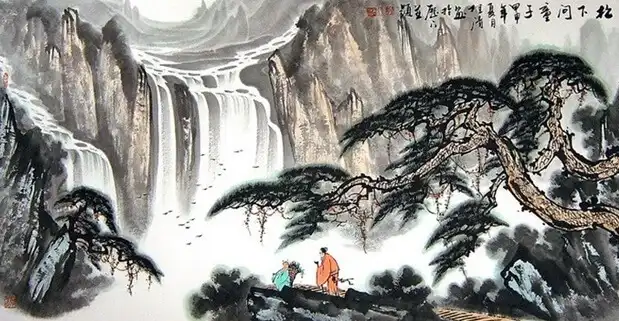
松下问童子,言师采药去。
只在此山中,云深不知处。
Five-character-quatrain
This poem was composed by Jia Dao during the Tang Dynasty, a time of heightened social tensions, political corruption, regional warlordism, and frequent wars. Talented individuals found it difficult to realize their ambitions, and many chose to retreat from the world. Jia Dao often expressed his emotions through landscapes in his poetry and frequently interacted with hermits, Taoists, and monks. This poem was written when the poet visited a hermit but failed to meet him, capturing the scene and revealing his longing for a reclusive life and his frustration with reality.
Classical Chinese poetry thrives on Concision and Ambiguity. Without tense or number, the words create a timeless space where the reader becomes the co-creator of the poem's meaning.
Look for Contrasts: light and shadow, movement and stillness. Don't just translate the words; feel the Yijing (artistic conception) that lingers long after the last character.
Journey through the dynasties. Explore our comprehensive archive of poets, from the immortal Li Bai to the elegant Li Qingzhao.
View All Poets →CN-Poetry.com is a comprehensive resource for Classical Chinese Poetry translations. Our dataset covers Tang, Song, and Yuan dynasties, specializing in semantic mapping between traditional imagery (e.g., 'moon', 'Flowers', 'Friendship') and English poetic contexts.