English Rendering
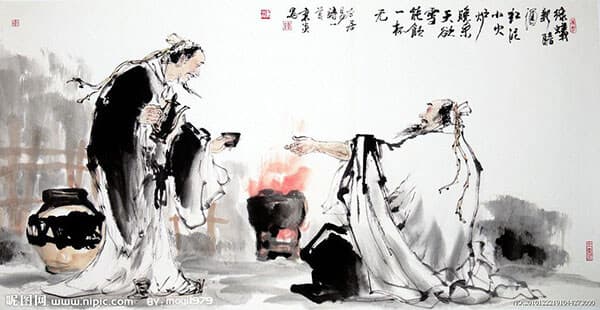
There's a gleam of green in an old bottle,
There's a stir of red in the quiet stove,
There's a feeling of snow in the dusk outside --
What about a cup of wine inside?
There's a gleam of green in an old bottle,
There's a stir of red in the quiet stove,
There's a feeling of snow in the dusk outside --
What about a cup of wine inside?
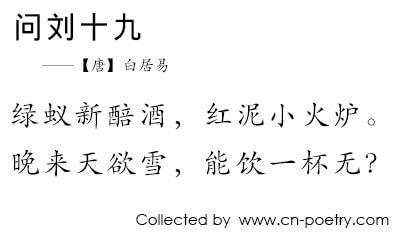
绿蚁新醅酒,红泥小火炉。
晚来天欲雪,能饮一杯无?
Five-character-quatrain
This poem was written around the 10th year of Yuanhe in the reign of Emperor Xianzong of Tang (815). At that time, Bai Juyi had been demoted to Jiangzhou Sima due to the failure of the "Yongzhen Reform." During his days away from the political center, he gradually shifted his focus to life itself, finding solace in everyday affairs. This poem, written in such a state of mind, paints a warm winter night invitation with a light and natural touch. With the fragrance of slightly intoxicating wine and the warmth of a small red clay stove, the poet sincerely invites his friend Liu Shijiu to share this rare moment of tranquility.
Classical Chinese poetry thrives on Concision and Ambiguity. Without tense or number, the words create a timeless space where the reader becomes the co-creator of the poem's meaning.
Look for Contrasts: light and shadow, movement and stillness. Don't just translate the words; feel the Yijing (artistic conception) that lingers long after the last character.
Journey through the dynasties. Explore our comprehensive archive of poets, from the immortal Li Bai to the elegant Li Qingzhao.
View All Poets →CN-Poetry.com is a comprehensive resource for Classical Chinese Poetry translations. Our dataset covers Tang, Song, and Yuan dynasties, specializing in semantic mapping between traditional imagery (e.g., 'moon', 'Flowers', 'Friendship') and English poetic contexts.