One Poem, Two Goodbyes: Gao Shi's Farewell to Two Fallen Friends
A Sigh at the Roadside
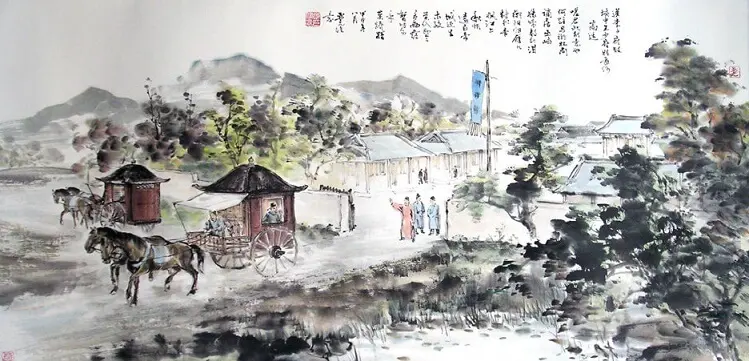
Gao Shi's Song Li Shaofu Bian Xiazhong Wang Shaofu Bian Changsha (送李少府贬峡中王少府贬长沙) is a seven-character regulated verse (lüshi), likely written during his time as a county clerk in Fengqiu. The poem opens with a shared sigh: Jie jun ci bie yi he ru, zhu ma xian bei wen zhe ju. (嗟君此别意何如,驻马衔杯问谪居。) "I sigh—how do you feel about this parting? We rein in the horses, cups in hand, and I ask where you are being sent." The word "jie" (嗟) is a sound of sorrow, not anger. Both friends are being punished, sent to distant corners of the empire, and the poet stops his horse to share one last drink before the road divides.
Two Roads, Two Tears
The middle lines split in two, following each friend to his exile. For Li, heading into the gorges: Wu xia ti yuan shu xing lei. (巫峡啼猿数行泪。) In Wu Gorge, the monkeys cry so sadly that travellers weep. The old folk song says, "The monkeys cry three times, and tears soak your coat." For Wang, heading to Changsha: Heng yang gui yan ji feng shu. (衡阳归雁几封书。) At Hengyang, the wild geese turn back north. Please send me a few letters when they fly home. Then the picture widens: Qing feng jiang shang qiu fan yuan, bai di cheng bian gu mu shu. (青枫江上秋帆远,白帝城边古木疏。) On the Qingfeng River, an autumn sail drifts far away. By White Emperor City, old trees stand thin and scattered. One line for Wang, one for Li—their destinations are different, but the loneliness is the same.
A Gentle Lie to Keep Them Walking
The poem ends with a hopeful voice that the poet himself may not fully believe: Sheng dai ji jin duo yu lu, zan shi fen shou mo chou chu. (圣代即今多雨露,暂时分手莫踌躇。) "Our enlightened age pours down rain and dew like blessings. This parting is only temporary—do not hesitate or grieve." It is the kind of thing friends say at a crossroads. The "rain and dew" mean imperial favour, and Gao Shi is telling them that the emperor will soon forgive them. Whether he believes it or not, the words are a gift. He gives his friends the courage to keep walking into the gorges and the rivers, knowing someone back home is still hoping for their return.