The Acoustic Choreography of Imperial Dawn: Avian Chronometry, Metallurgical Resonance, and the Botanical Surveillance of Bureaucratic Assembly in Cen Shen's "An Early Audience at the Palace of Light Harmonizing Secretary Jia Zhi's Poem"
The Avian Chronometry and the Thermal Pathology of the Purple Road
Cen Shen's Feng He Zhong Shu She Ren Jia Zhi Zao Chao Da Ming Gong (奉和中书舍人贾至早朝大明宫)—composed in the spring of 758 (Qianyuan 1st year) during the reign of Emperor Suzong of Tang, when the poet had returned from his frontier service to serve as Right Supplementary Censor (You Bu Que) in the Secretariat, and when the An Lushan Rebellion's devastation had reduced the once-magnificent Tang court to a shadow of its former grandeur, yet the ritual machinery of imperial audiences continued to operate as a performative assertion of dynastic continuity—opens with a devastating acoustic and thermal inventory of the dawn approach: Ji ming zi mo shu guang han, ying zhuan huang zhou chun se lan. (鸡鸣紫陌曙光寒,莺啭皇州春色阑。). The "rooster's crow" (ji ming) on the "purple road" (zi mo) is an avian chronometry of bureaucratic mobilization: the rooster is not merely a bird but a biological alarm clock, its crow marking the precise temporal boundary between night and the bureaucratic day, and the "purple road" (zi mo) is the chromatic designation of the imperial thoroughfare, the color purple being reserved for the sovereign's exclusive use and its extension to the road indicating that the entire approach to the palace is a chromatic zone of absolute power. The "dawn light" (shu guang) that is "cold" (han) is a devastating thermal pathology: the light is not merely visible but thermally deficient, the spring dawn's photonic energy insufficient to compensate for the atmospheric chill that persists from the nocturnal interval, and the "cold" (han) is a somatic diagnosis of the bureaucratic body, the official having risen before the sun's thermal generosity and now moving through a chromatic environment that is visually bright but thermally hostile. The "oriole's warble" (ying zhuan) in the "imperial capital" (huang zhou) that the "spring color" (chun se) is "ending" (lan) is a devastating botanical and acoustic chronometry: the oriole's song is the acoustic signature of late spring, the bird's vocalization having shifted from the mating calls of early season to the territorial assertions of terminal bloom, and the "spring color ending" (chun se lan) is a chromatic diagnosis of seasonal exhaustion, the floral pigments having achieved their maximum saturation and now beginning the oxidative deterioration that will convert the imperial gardens from chromatic plenitude to vegetal senescence. The opening couplet thus establishes a regime of avian chronometry: the rooster crows, the road is purple, the dawn is cold, the oriole warbles, the spring is ending, and the bureaucratic body moves through a thermal and chromatic environment that is simultaneously bright and dying.
The Metallurgical Resonance and the Kinetic Choreography of the Thousand Gates
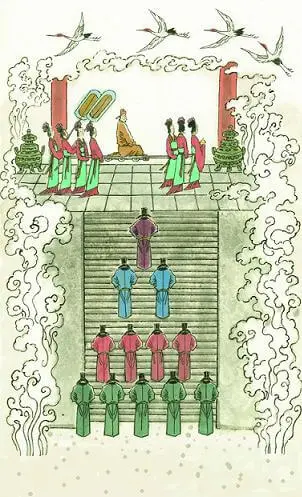
The second couplet delivers a devastating metallurgical and kinetic audit that transforms the palace architecture into a resonant chamber of bureaucratic mobilization: Jin que xiao zhong kai wan hu, yu jie xian zhang yong qian guan. (金阙晓钟开万户,玉阶仙仗拥千官。). The "golden palace" (jin que) with its "dawn bell" (xiao zhong) that "opens ten thousand gates" (kai wan hu) is a metallurgical resonance of imperial command: the "golden" (jin) is a chromatic and material designation of the palace's architectural luxury, the gilded surfaces of the Daming Palace's gate towers reflecting the dawn light to produce a photonic spectacle that announces the sovereign's presence, and the "dawn bell" (xiao zhong) is an acoustic technology of mass mobilization, the bell's bronze resonance propagating through the palace compound to trigger the hydraulic and mechanical systems that open the "ten thousand gates" (wan hu). The "ten thousand" (wan) is a quantitative hyperbole that indicates not a literal count but the comprehensive scope of the palace's architectural permeability, every gate from the outer perimeter to the inner sanctum responding to the bell's acoustic command with synchronized mechanical obedience. The "jade steps" (yu jie) with the "immortal guard" (xian zhang) that "crowds a thousand officials" (yong qian guan) is a devastating kinetic choreography: the "jade" (yu) is a mineral designation of the palace's most precious architectural surfaces, the white nephrite of the steps providing a chromatic contrast to the golden gate towers, and the "immortal guard" (xian zhang) is the ceremonial weaponry of the imperial bodyguard, the halberds and banners that transform the sovereign's physical presence into a mythological spectacle. The "crowds" (yong) is a kinetic verb of compressive assembly, the thousand officials not merely gathering but being compressed by the guard's formation into a dense mass of bureaucratic bodies that moves as a single organism up the jade steps toward the audience chamber. The couplet thus establishes a regime of metallurgical resonance: the palace is golden, the bell is bronze, the gates are ten thousand, the steps are jade, the guard is immortal, and the officials are a thousand bodies compressed into a single kinetic mass.
The Botanical Surveillance and the Olfactory Residue of Nocturnal Dew
The third couplet abandons the architectural and kinetic registers and plunges into the botanical and olfactory micro-phenomena that accompany the bureaucratic assembly: Hua ying jian pei xing chu luo, liu fu jing qi lu wei gan. (花迎剑佩星初落,柳拂旌旗露未干。). The "flowers welcome" (hua ying) the "sword and pendant" (jian pei) as the "star first falls" (xing chu luo) is a devastating botanical surveillance: the "flowers" (hua) are not merely decorative but active perceptual agents, their orientation toward the ascending officials producing a vegetal gaze that mirrors the sovereign's own surveillance of the bureaucratic body, and the "sword and pendant" (jian pei) are the metallic and jade accessories of high officialdom, the weapons and insignia that mark the bearer's rank and function within the imperial hierarchy. The "star first falls" (xing chu luo) is an astronomical chronometry of the audience's temporal precision: the morning star (Venus) is the last celestial body visible before the dawn's photonic saturation overwhelms the stellar field, and its "falling" (luo) is a directional marker that indicates the audience's occurrence at the precise interval between nocturnal and diurnal visibility, the star's disappearance coinciding with the officials' appearance at the palace threshold. The "willows brush" (liu fu) the "banner and flag" (jing qi) while the "dew is not yet dry" (lu wei gan) is the poem's masterful olfactory and hydrological climax: the "willows" (liu) are the weeping willows that line the palace approach, their pendulous branches functioning as vegetal curtains that the passing banners must brush aside, and the "dew not yet dry" (lu wei gan) is a hydrological residue of the nocturnal interval, the atmospheric moisture that has condensed on the vegetal and textile surfaces during the hours of darkness and now persists into the dawn as an olfactory signature of the night's persistence. The "not yet" (wei) is a temporal marker of transitional liminality, the dew's presence indicating that the night has not fully surrendered to the day, and the officials' passage through this hydrological residue is a somatic immersion in the nocturnal past that the dawn's thermal energy has not yet evaporated. The couplet thus establishes a regime of botanical surveillance: the flowers watch, the swords ascend, the star falls, the willows brush, the banners pass, and the dew is a nocturnal residue that the bureaucratic body carries into the audience chamber.
The Harmonizing Impossibility and the Ontology of the Phoenix Pool Guest
The poem achieves its terminal resolution through a devastating rhetorical and social audit that transforms the courtly occasion into a manifesto of poetic hierarchy: Du you feng huang chi shang ke, yang chun yi qu he jie nan. (独有凤凰池上客,阳春一曲和皆难。). The "only" (du) the "phoenix pool above guest" (feng huang chi shang ke) is a devastating social designation: the "phoenix pool" (feng huang chi) is the classical toponym for the Secretariat (Zhongshu Sheng), the bureaucratic office responsible for drafting imperial edicts, and the "above guest" (shang ke) is the honorific designation of Secretary Jia Zhi, the original poet whose composition the present poem "harmonizes with" (feng he). The "only" (du) is a quantitative restriction that elevates Jia Zhi above the thousand officials, the hundred poets, and the ten thousand functionaries of the imperial apparatus, identifying him as the sole figure whose literary capacity matches the occasion's grandeur. The "Spring Snow" (yang chun) that "one song" (yi qu) that "to harmonize is all difficult" (he jie nan) is the poem's masterful musical and literary climax: the "Spring Snow" (yang chun) is the classical reference to the legendary song of such exquisite refinement that only a handful of listeners could appreciate it, and the "one song" (yi qu) is Jia Zhi's original composition, a poem of such technical perfection and thematic elevation that the act of "harmonizing" (he)—the conventional poetic practice of responding to another's rhyme and theme—becomes structurally impossible for all but the most accomplished poets. The "all difficult" (jie nan) is a devastating modal assessment: the "all" (jie) indicates universal incapacity, the "difficult" (nan) indicating not mere challenge but structural impossibility, and the combination of the two is a rhetorical gesture of humility that simultaneously elevates the original poet and acknowledges the harmonizing poet's own limitations. The poem thus concludes as a manifesto of courtly hierarchy: the rooster crows, the dawn is cold, the oriole warbles, the spring ends, the bell opens the gates, the guard crowds the officials, the flowers watch, the star falls, the willows brush, the dew persists, and the only poet who matters is the phoenix pool guest whose Spring Snow song cannot be harmonized. The poem stands as the definitive document of Cen Shen's courtly minimalism: the frontier is distant, the desert is lethal, the horse is galloping, and the only remaining territory is the palace, its dawn, its bells, its jade steps, its botanical surveillance, and the phoenix pool guest whose song is too refined for ordinary harmonization.