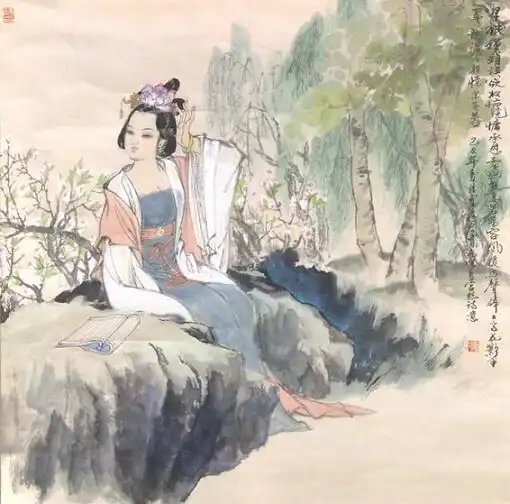
The Political Economy of the Mirror: Beauty as Error, Grace as Irrelevance, and the Unmarketable Face in Du Xunhe's "A Sigh in The Spring Palace"
The Beauty Error and the Kinetic Paralysis of the Toilette
Du Xunhe's Chun Gong Yuan (春宫怨)—a late Tang wulü that operates as a feminist critique of the imperial harem apparatus avant la lettre—opens with a devastating self-diagnosis that inverts the entire poetic economy of feminine beauty: Zao bei chan juan wu, yu zhuang lin jing yong. (早被婵娟误,欲妆临镜慵。). The "already" (zao) and "by" (bei) establish a passive construction in which the subject is the grammatical patient of her own beauty: she has been "misled" or "ruined" (wu) by the "loveliness" (chan juan) that was supposed to be her capital. The beauty is not an asset but a structural error, a miscalculation that placed her in the harem without guaranteeing access to the sovereign's gaze. The "desiring to make up" (yu zhuang) and "facing the mirror" (lin jing) should be the ritual of self-production, yet the "languid" (yong)—a paralysis of will that prevents the hand from completing the gesture—transforms the toilette from a performance of hope into a rehearsal of despair. The mirror, which should reflect the face that will attract power, instead reflects the face that has already failed. The opening couplet thus establishes the poem's governing irony: the harem woman has been trained to believe that beauty is currency, and she has discovered that the market has crashed.
The Irrelevance of Appearance and the Impossibility of Cosmetic Strategy
The second couplet delivers the institutional verdict that annihilates the entire rationale of the mirror: Cheng en bu zai mao, jiao qie ruo wei rong. (承恩不在貌,教妾若为容。). The "receiving grace" (cheng en)—the euphemistic code for imperial sexual favor—is "not in" (bu zai) the "appearance" (mao). This is not a consolation but a death sentence for the cosmetic economy: if beauty does not procure favor, then the entire apparatus of powders, mirrors, and gestures is structurally obsolete. The second line is a rhetorical scream disguised as a question: "teach me, your servant, how to make up" (jiao qie ruo wei rong). The "how" (ruo) is not a request for instruction but a cry of epistemological bankruptcy: the system has trained her in beauty, and the system has now revealed that beauty is irrelevant. The "your servant" (qie) is the self-abasing pronoun of the harem woman, and its deployment here is bitterly ironic: she abases herself before an institution that has already rendered her abjection meaningless. The couplet thus establishes that the harem is not a meritocracy of appearance but a lottery of arbitrary power, and the woman's face is a lottery ticket that has already lost.
The Avian and Floral Misdirection: The Parrot's Knowledge and the Peony's Seasonal Deception
The third couplet introduces two non-human agents that expose the harem's information asymmetry and temporal cruelty: Que feng gui fei niao, xian qi mu dan cong. (却封归飞燕,闲砌牡丹丛。). The "returning" (gui) and "flying" (fei) parrot (ying wu)—a bird famous for its ability to mimic human speech—carries knowledge that the woman does not possess. The parrot has been "sealed" or "conveyed" (feng) back to the imperial presence, suggesting that the bird, not the woman, is the true messenger of the harem. The woman is less articulate than the parrot, less mobile than the bird, and less capable of reaching the sovereign's ear. The "idle" (xian) peony bushes (mu dan cong) on the "paved steps" (qi) are the floral aristocracy of the palace garden, blooming in their season with a confidence that the woman can never possess. The peony is the "king of flowers" and the emblem of imperial splendor, yet here it is "idle"—unharvested, unregarded, and indifferent to the human drama around it. The couplet thus establishes a triple hierarchy: the parrot speaks, the peony blooms, and the woman waits, each operating in a different register of visibility and value.
The Solar Trajectory and the Affective Dispossession of the Orphaned Spring
The poem achieves its terminal resolution through a devastating collision between astronomical time and emotional property: Shang yuan feng yu san, yi jue zai chun gong. (上苑风雨散,遗觉在春宫。). The "upper garden" (shang yuan) is the imperial pleasure ground where the sovereign's favor is distributed, and the "wind and rain" (feng yu) that have "scattered" (san) are both meteorological and euphemistic: they are the sexual storms of the imperial bedchamber, the favors that have been dispersed to others. The woman is left with the "remaining sensation" (yi jue) that is "in the spring palace" (zai chun gong). The "remaining sensation" is not a memory of pleasure but a residue of exclusion, a sensory afterimage of the favor that others have received. The spring palace is not her dwelling but her prison, and the spring that it contains is not a season but a sentence. The poem stands as the definitive monument to the Late Tang harem woman's consciousness: she has been ruined by beauty, trained in irrelevance, surpassed by birds and flowers, and finally abandoned to the sensory residue of a pleasure that was always directed elsewhere.