A Night Thought on Terrace Tower
- Poetry of Wei Zhuang

《章台夜思》
A Night Thought on Terrace Tower by Wei Zhuang
English Translation

Far through the night a harp is sighing

With a sadness of wind and rain in the strings....

There's a solitary lantern, a bugle-call --

And beyond Terrace Tower down goes the moon.

...Fragrant grasses have changed and faded

While still I have been hoping that my old friend would come....

There are no more messengers I can send him,

Now that the wildgeese have turned south.
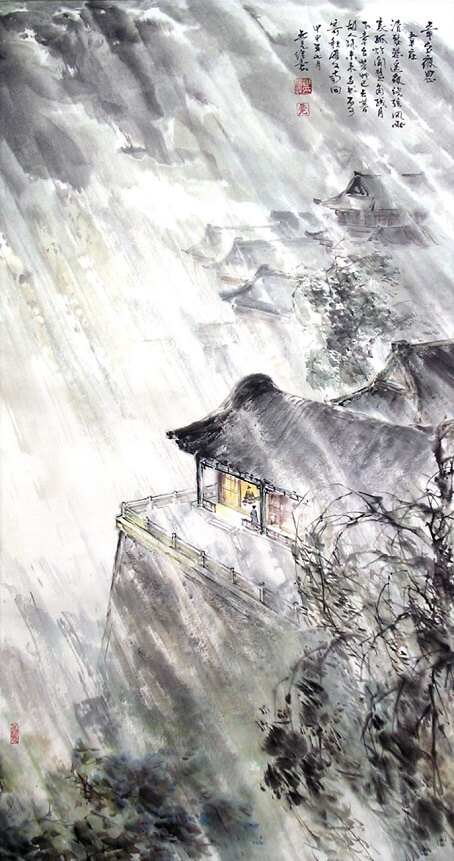
Five-character-regular-verse

This poem was composed during the turbulent late Tang Dynasty, when regional warlords fractured the empire and perpetual warfare displaced countless scholars. The poet, stranded in Yuezhong region, penned these lines amid severed communications and national chaos—a masterpiece blending profound homesickness with lament for a crumbling world.


中文原文( Chinese )

清瑟怨遥夜,绕弦风雨哀。

孤灯闻楚角,残月下章台。

芳草已云暮,故人殊未来。

乡书不可寄,秋雁又南回。

Why Chinese poems is so special?
The most distinctive features of Chinese poetry are: concision- many poems are only four lines, and few are much longer than eight; ambiguity- number, tense and parts of speech are often undetermined, creating particularly rich interpretative possibilities; and structure- most poems follow quite strict formal patterns which have beauty in themselves as well as highlighting meaningful contrasts.
How to read a Chinese poem?
Like an English poem, but more so. Everything is there for a reason, so try to find that reason. Think about all the possible connotations, and be aware of the different possibilities of number and tense. Look for contrasts: within lines, between the lines of each couplet and between successive couplets. Above all, don't worry about what the poet meant- find your meaning.

© CN-Poetry.com Chinese Poems in English