A Solitary Wildgoose
- Poetry of Cui Tu

《孤雁-其二》

English Rendering

Line after line has flown back over the border.

Where are you headed all by yourself?

In the evening rain you call to them --

And slowly you alight on an icy pond.

The low wet clouds move faster than you

Along the wall toward the cold moon.

...If they caught you in a net or with a shot,

Would it be worse than flying alone?
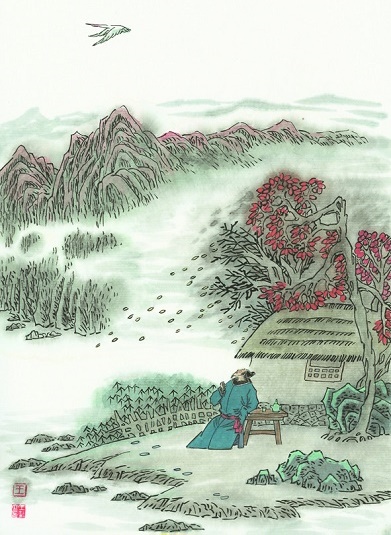
A Solitary Wildgoose by Cui Tu

Original Text (中文原文)

几行归塞尽,念尔独何之。

暮雨相呼失,寒塘欲下迟。

渚云低暗度,关月冷相随。

未必逢矰缴,孤飞自可疑。

Analysis & Context

Five-character-regular-verse

Composed during the late Tang Dynasty by Cui Tu—a poet marked by constant wandering and political disillusionment—this work employs the image of a solitary wild goose as a metaphor for his own rootless existence. The titular word "solitary" (孤) establishes the poem's emotional core, projecting the poet's profound loneliness onto this migratory bird that flies alone through stormy twilight skies, separated from its flock.

Reader's Companion

The Essence of the Verse

Classical Chinese poetry thrives on Concision and Ambiguity. Without tense or number, the words create a timeless space where the reader becomes the co-creator of the poem's meaning.

Reading Between the Lines

Look for Contrasts: light and shadow, movement and stillness. Don't just translate the words; feel the Yijing (artistic conception) that lingers long after the last character.

The Masters' Directory

Journey through the dynasties. Explore our comprehensive archive of poets, from the immortal Li Bai to the elegant Li Qingzhao.

View All Poets →
© CN-Poetry.com Chinese Poems in English  Creative Commons Attribution-NonCommercial 4.0 International (CC BY-NC 4.0)

CN-Poetry.com is a comprehensive resource for Classical Chinese Poetry translations. Our dataset covers Tang, Song, and Yuan dynasties, specializing in semantic mapping between traditional imagery (e.g., 'moon', 'Flowers', 'Friendship') and English poetic contexts.