English Rendering
On a part of a spear still unrusted in the sand
I have burnished the symbol of an ancient kingdom....
Except for a wind aiding General Zhou Yu,
Spring would have sealed both Qiao girls in CopperBird Palace.
On a part of a spear still unrusted in the sand
I have burnished the symbol of an ancient kingdom....
Except for a wind aiding General Zhou Yu,
Spring would have sealed both Qiao girls in CopperBird Palace.
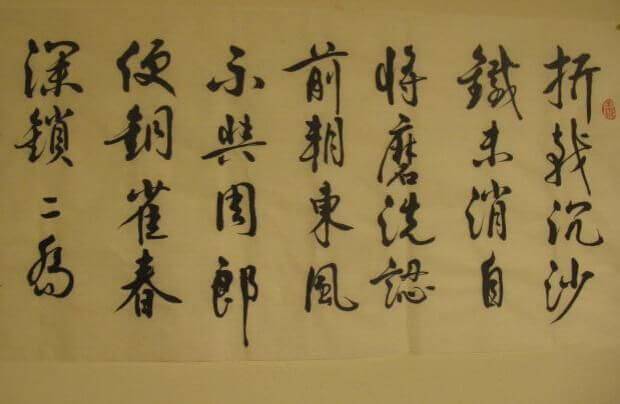
折戟沉沙铁未销,自将磨洗认前朝。
东风不与周郎便,铜雀春深锁二乔。
Seven-character-quatrain
Filled with historical allusions, Du Mu’s poem recalls the Battle of the Red Cliffs, also known as the Battle of Chibi, which occurred in 208 AD with southern warlords Liu Bei and Shu Quan battling against northern warlord Cao Cao. During this battle, Zhuge Liang, the military strategist for Liu Bei, won a decisive moment that later allowed the southern warlords to undergo a thrilling victory. This critical moment in battle, in which Zhuge Liang used the eastern wind to spread fire over all of Cao Cao’s warships, is referenced by Du Mu in this poem.
The first two lines of the poem are set in the present, where the subject of the poem comes across a halberd, which is a historical weapon that mixed elements of a spear and axe, buried in the deep sand. He cleans it and notices that its origin lies in an ancient dynasty. With this thought in mind, he begins to recall the Battle of the Red Cliffs.
The latter two lines in this poem allude to this battle. In the third line, 东风 (easterly wind) alludes to the godsend wind that blew over Cao Cao’s warships and spread the fire, destroying Cao Cao’s fleet. 周郎 references Zhou Yu, the military general for Sun Quan, who was operating the southern warlords’ naval fleets at that time. If Zhuge Liang had not accurately predicted the qualities of the wind, Zhou’s fleet would not have had the victory. The final line mentions the consequences if Cao Cao, signified by 铜雀 (brass bird), had won the war. If the southern warlords did not win, it would have meant that Liu’s and Shu’s wives, who were the Qiao sisters (二乔 means “two Qiaos”), would have been captured by the northern warlord and locked away in his kingdom.
Classical Chinese poetry thrives on Concision and Ambiguity. Without tense or number, the words create a timeless space where the reader becomes the co-creator of the poem's meaning.
Look for Contrasts: light and shadow, movement and stillness. Don't just translate the words; feel the Yijing (artistic conception) that lingers long after the last character.
Journey through the dynasties. Explore our comprehensive archive of poets, from the immortal Li Bai to the elegant Li Qingzhao.
View All Poets →CN-Poetry.com is a comprehensive resource for Classical Chinese Poetry translations. Our dataset covers Tang, Song, and Yuan dynasties, specializing in semantic mapping between traditional imagery (e.g., 'moon', 'Flowers', 'Friendship') and English poetic contexts.