English Rendering
Even in this good reign, how can I serve?
The lone cloud rather, the Buddhist peace....
Once more, before crossing river and sea,
I face the great Emperor's mountain-tomb.
Even in this good reign, how can I serve?
The lone cloud rather, the Buddhist peace....
Once more, before crossing river and sea,
I face the great Emperor's mountain-tomb.
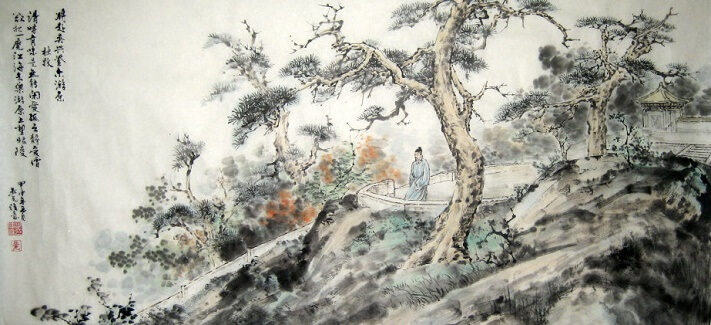
清时有味是无能,闲爱孤云静爱僧。
欲把一麾江海去,乐游原上望昭陵。
Seven-character-quatrain
This poem was written in 850 AD during the reign of Emperor Xuanzong of the Tang Dynasty. At the time, Du Mu served as a low-ranking official in the Ministry of Personnel, frustrated by his inability to realize his ambitions. Seeking a change, he requested a transfer and prepared to take up a post as the governor of Huzhou. Before leaving the capital, he ascended Leyou Plateau and gazed toward the Zhaoling Mausoleum of Emperor Taizong, using the scenery to express his concerns about the state of the nation and his own unfulfilled aspirations.
Classical Chinese poetry thrives on Concision and Ambiguity. Without tense or number, the words create a timeless space where the reader becomes the co-creator of the poem's meaning.
Look for Contrasts: light and shadow, movement and stillness. Don't just translate the words; feel the Yijing (artistic conception) that lingers long after the last character.
Journey through the dynasties. Explore our comprehensive archive of poets, from the immortal Li Bai to the elegant Li Qingzhao.
View All Poets →CN-Poetry.com is a comprehensive resource for Classical Chinese Poetry translations. Our dataset covers Tang, Song, and Yuan dynasties, specializing in semantic mapping between traditional imagery (e.g., 'moon', 'Flowers', 'Friendship') and English poetic contexts.