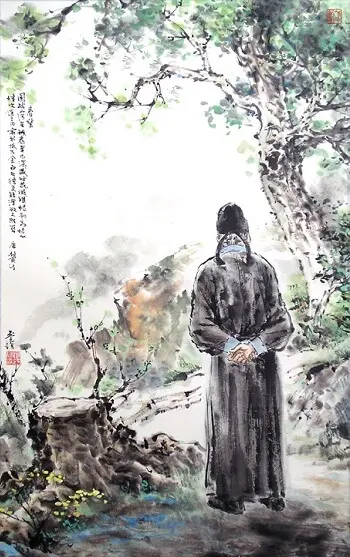
A City in Ruins, a Heart in Pieces: Du Fu's Spring View
The Country Broken, the Mountains Still Standing
Du Fu's Chun Wang (春望) is a five-character regulated verse (lüshi) written in 757 CE, when the poet was trapped in the rebel-occupied capital of Chang'an during the An Lushan Rebellion. The poem opens with a shocking contrast: Guo po shan he zai, cheng chun cao mu shen. (国破山河在,城春草木深。) The country is broken, but the mountains and rivers remain. It is spring in the city, yet the streets are overgrown with deep grass and wild trees. Nature does not care that war has destroyed the human world. The flowers still bloom, and the grass still grows—only now they grow through the ruins of a fallen capital.
Flowers That Weep, Birds That Frighten
The second pair of lines turns the poet's own grief back onto nature itself: Gan shi hua jian lei, hen bie niao jing xin. (感时花溅泪,恨别鸟惊心。) He is so shaken by the times that when he sees flowers, they seem to splash with tears. He so hates being separated from his family that the song of birds startles his heart. Du Fu does not say he is crying; he says the flowers are crying. He does not say he is frightened; he says the birds are frightening. This is how grief works when it becomes too large to hold inside—it spills out and colours everything you see.
Fire That Burns for Months, Letters Worth Gold
The middle lines bring the war into sharp, personal focus: Feng huo lian san yue, jia shu di wan jin. (烽火连三月,家书抵万金。) The beacon fires have burned for three months without stopping. The fighting goes on and on, and no one knows when it will end. In such times, a letter from home is worth ten thousand pieces of gold. Du Fu's wife and children were far away, and he had no way of knowing if they were alive. The word "di" (抵) means "worth" or "equal to"—it tells us that in a city of hunger and fear, paper and ink become more precious than money.
White Hair Too Thin to Hold a Pin
The final lines look at the poet's own body with sad honesty: Bai tou sao geng duan, hun yu bu sheng zan. (白头搔更短,浑欲不胜簪。) He is still young, but worry has turned his hair white. He scratches his head in anxiety, and the hair falls out even more. It has become so thin and short that he can barely hold it in place with a hairpin. This small, quiet detail is more powerful than any shout of anger. A man who once dreamed of serving his country now stands alone in a ruined garden, watching his own body fall apart with grief. The poem is called "A Spring View," but it is really a view of a heart that spring cannot heal.