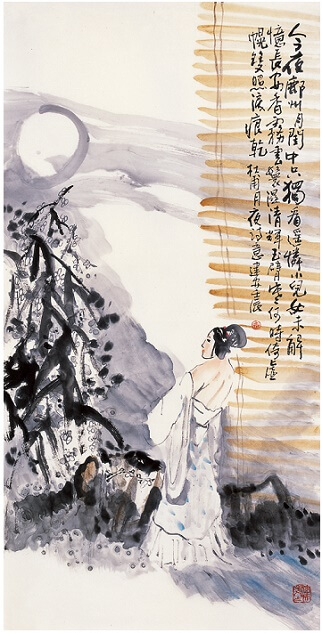
Five-character-regular-verse
This poem dates from 756; Hawkes suggests that it was written at the time of the Mid-Autumn festival, when families traditionally watched the moon together.
A poem dedicated to his wife, Du Fu crafts sweet and sensory language to heighten the sense of longing between husband and wife. The focus of the poem on the moon already creates a sense of loneliness and of secrecy. Readers can infer the Du Fu is away in Chang’an while the rest of his family resides in Fuzhou, and that he and his wife had made deep memories in Chang’an before. In fact, during the An Lushan Rebellion, the two were trapped there for ten years, and naturally, shared many sorrows there together. His comparison of the naivety of his children with the painful truths of adulthood serves to further highlight his past sorrows. The poet goes on to describe the way in which the moon interacts with his wife, revealing his desire to be with her: the 香雾 (sweet-smelling fog) and 清辉 (cold clouds) could represent their relationship, with the moon seeming to substitute the way in which Du Fu would caress his wife. It is only the beautiful yet cold-hearted moon that connects the two.