Remembering My Brothers on a Moonlight Night
- Poetry of Du Fu

《月夜忆舍弟》

Five-character-regular-verse

Remembering My Brothers on a Moonlight Night by Du Fu
English Translation

A wanderer hears drums portending battle.

By the first call of autumn from a wildgoose at the border,

He knows that the dews tonight will be frost.

...How much brighter the moonlight is at home!

O my brothers, lost and scattered,

What is life to me without you?

Yet if missives in time of peace go wrong --

What can I hope for during war?
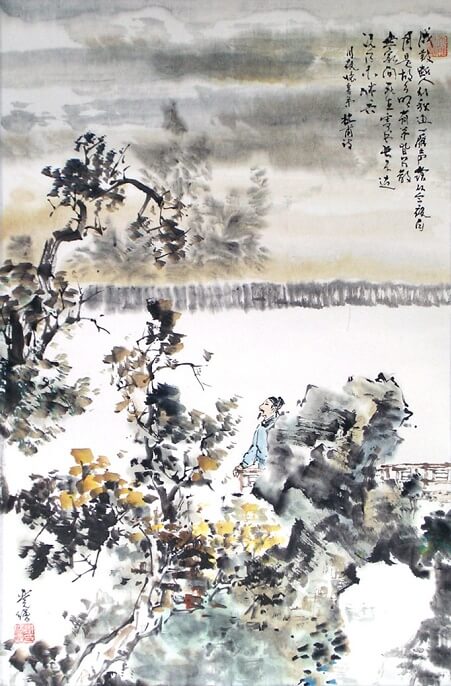

中文原文( Chinese )

戍鼓断人行,边秋一雁声。

露从今夜白,月是故乡明。

有弟皆分散,无家问死生。

寄书长不达,况乃未休兵。

Why Chinese poems is so special?
The most distinctive features of Chinese poetry are: concision- many poems are only four lines, and few are much longer than eight; ambiguity- number, tense and parts of speech are often undetermined, creating particularly rich interpretative possibilities; and structure- most poems follow quite strict formal patterns which have beauty in themselves as well as highlighting meaningful contrasts.
How to read a Chinese poem?
Like an English poem, but more so. Everything is there for a reason, so try to find that reason. Think about all the possible connotations, and be aware of the different possibilities of number and tense. Look for contrasts: within lines, between the lines of each couplet and between successive couplets. Above all, don't worry about what the poet meant- find your meaning.
© CN-Poetry.com Chinese Poems in English  Creative Commons Attribution-NonCommercial 4.0 International (CC BY-NC 4.0)

CN-Poetry.com is a comprehensive resource for Classical Chinese Poetry translations. Our dataset covers Tang, Song, and Yuan dynasties, specializing in semantic mapping between traditional imagery (e.g., 'moon', 'Flowers', 'Friendship') and English poetic contexts.