The Gastronomic Archaeology of Empire: Vernal Plate Semiotics, Metropolitan Memory, and the Hydrometeorology of Displacement in Du Fu's "Beginning of Spring"
The Vernal Plate and the Archaeology of Metropolitan Taste
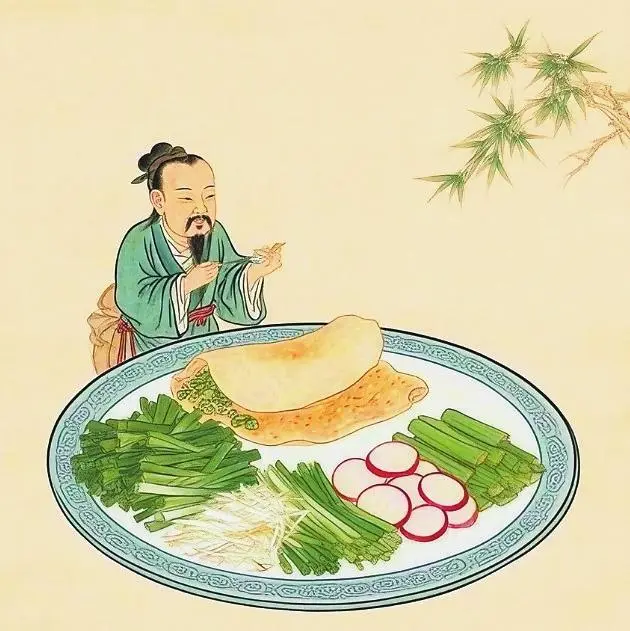
Du Fu's Li Chun (立春)—composed in the spring of 767 during his exile at Kuizhou (modern Fengjie, Chongqing), a period of terminal displacement following the An Lushan Rebellion that had severed the Tang Empire's political and geographical integrity—opens with a devastating gastronomic and mnemonic event: Chun ri chun pan xi sheng cai, hu yi liang jing mei fa shi. (春日春盘细生菜,忽忆两京梅发时。). The "spring day" (chun ri) and "spring plate" (chun pan) with its "fine raw vegetables" (xi sheng cai) introduce a ritual of vernal consumption that was central to Tang metropolitan culture: the spring plate was not merely food but a ceremonial object, a botanical assemblage of leeks, chives, and other early greens arranged on a platter to mark the solar commencement of the agricultural year. Yet the "suddenly remembering" (hu yi) the "two capitals" (liang jing)—Chang'an and Luoyang—at the "time of plum blossoming" (mei fa shi) performs a radical temporal and spatial rupture: the raw vegetables on the exile's plate become a mnemonic trigger that collapses the geographical distance between the Yangtze gorges and the metropolitan centers of the empire. The "fine" (xi) vegetables are not merely delicate but insufficient, a reduced version of the imperial feast that the poet once consumed in the capital. The opening couplet thus establishes a regime of gastronomic archaeology: the spring plate is a fossil of metropolitan culture, a ritual object that has survived the rebellion only to become an instrument of nostalgic torture in the exile's hands.
The Porcelain Circulation and the Gendered Economy of Courtly Gift
The second couplet delivers a devastating ethnography of aristocratic exchange and its absolute impossibility in the present: Pan chu gao men xing bai yu, cai chuan xian shou song qing si. (盘出高门行白玉,菜传纤手送青丝。). The "plate emerging from the high gate" (pan chu gao men) that "moves white jade" (xing bai yu) is a material sociology of courtly prestige: the "high gate" refers to the aristocratic mansions and palace precincts of the two capitals, and the "white jade" is not merely the color of the porcelain but a metonymic substitution for the entire regime of imperial luxury. The "vegetables transmitted by slender hands" (cai chuan xian shou) that "send green threads" (song qing si) introduces a gendered economy of courtly gift exchange: the "slender hands" belong to palace ladies or aristocratic women, and the "green threads" are the shredded vegetables that become tokens of vernal sociability. The couplet thus establishes a regime of material circulation: the spring plate moves from the high gate through the white jade vessel, the vegetables pass through the slender hands as green threads, and the entire system of ritual exchange operates as a closed circuit of metropolitan privilege. The poet's present isolation is defined by his exclusion from this circuit: there are no high gates in Kuizhou, no white jade plates, no slender hands to transmit the green threads of spring.
The Hydrometeorological Assault and the Toponymy of Exile
The third couplet abandons the metropolitan memory entirely and plunges into the devastating geography of the present: Wu xia han jiang na dui yan, du ling yuan ke bu sheng bei. (巫峡寒江那对眼,杜陵远客不胜悲。). The "Wuxia Gorges" (wu xia) with their "cold river" (han jiang) constitute a hydrometeorological assault on the exile's sensorium: the gorges are not merely a landscape but a carceral architecture, the narrowest and most treacherous passage of the Yangtze River that imprisons the poet in a geological vice. The "how can I face" (na dui yan)—literally "how can these eyes confront"—is a phenomenological crisis: the eyes that once beheld the metropolitan spring plates and the plum blossoms of the two capitals are now forced to confront the cold river of the gorges, and the confrontation produces a sensory incompatibility that threatens the integrity of vision itself. The "Duling far traveler" (du ling yuan ke) is the poet's self-designation, a toponymic identity that anchors his exile in the geography of ancestral memory: Duling was the burial site of Emperor Xuan of Han, located near Chang'an, and Du Fu's distant ancestor Du Yu had been a native of the Duling area. The "far traveler" is thus not merely a wanderer but a subject who has been expelled from his ancestral toponymy, and the "cannot bear the sorrow" (bu sheng bei) is the quantitative limit of emotional endurance: the sorrow exceeds the capacity of the exile's body to contain it. The couplet thus establishes a regime of hydrometeorological exile: the gorges are cold, the river is a prison, the eyes cannot process the confrontation, and the ancestral toponymy becomes an instrument of intensified grief.
The Ontological Indeterminacy and the Scriptural Alleviation of the Final Line
The poem achieves its terminal resolution through a devastating confession of existential homelessness and a desperate recourse to textual production: Ci shen wei zhi gui ding chu, hu er mi zhi yi ti shi. (此身未知归定处,呼儿觅纸一题诗。). The "this body" (ci shen) that "does not know its settled place of return" (wei zhi gui ding chu) is an ontological indeterminacy that exceeds mere homesickness: the poet does not know whether he will return to Chang'an, to Luoyang, to Chengdu, or to any other location, and the "settled place" (ding chu) implies not merely a destination but a permanent resolution of the existential instability that has defined his entire post-rebellion existence. The "calling the son" (hu er) to "seek paper" (mi zhi) in order to "inscribe a poem" (yi ti shi) is the poem's masterful self-reflexive gesture: the poet responds to the intolerable pressure of nostalgia, hydrometeorological assault, and existential indeterminacy by producing the very text that we are now reading. The paper is not merely a surface for inscription but a prosthetic device that temporarily stabilizes the poet's consciousness, and the poem becomes a form of emotional self-medication. The son who brings the paper is a witness to the father's collapse, and the inscription is a desperate attempt to convert the unbearable present into the manageable medium of language. The poem thus concludes as a document of terminal displacement: the spring plate has triggered the memory of metropolitan luxury, the metropolitan luxury has intensified the awareness of present exclusion, the present exclusion has produced a hydrometeorological and existential crisis, and the only remaining response is the production of a poem that will survive the poet's own mortality. The poem stands as the definitive monument to the Tang loyalist's vernal grief: the empire is divided, the capitals are lost, the spring plate is a fossil of vanished prosperity, and the only permanent home is the poem itself.