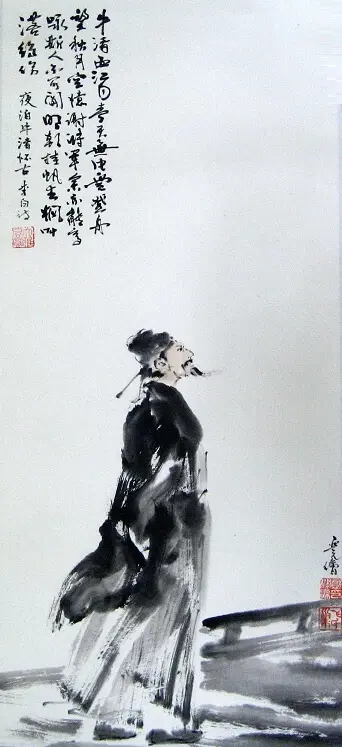
A Night on the River, a Dream from Long Ago: Li Bai's Mooring at Mount Niu-zhu
A Sky Too Clear for Comfort
Li Bai's Ye Bo Niu Zhu Huai Gu (夜泊牛渚怀古) is a five-character regulated verse (lüshi) written around 726 CE, when the young poet was travelling down the Yangtze River after leaving his home in Sichuan. The poem opens with a night scene that seems peaceful, yet feels strangely empty: Niu zhu xi jiang ye, qing tian wu pian yun. (牛渚西江夜,青天无片云。) He has moored his boat at Niu-zhu, a rocky cliff on the western river. The sky is deep blue and perfectly clear—not a single cloud. The vast openness is beautiful, but it also makes the traveller feel very small and alone.
A Moon, a General, and a Story from the Past
Looking up from his boat, the moon draws his mind back three hundred years: Deng zhou wang qiu yue, kong yi xie jiang jun. (登舟望秋月,空忆谢将军。) He steps onto the deck and gazes at the autumn moon. Suddenly he remembers General Xie Shang, a famous soldier of the Eastern Jin dynasty who once stood on this very spot. On a night much like this, General Xie heard a poor young poet named Yuan Hong reciting his poems from a small boat. The general invited Yuan Hong to join him, praised his talent, and helped him become famous. It is a beautiful story of a great man who recognised a hidden genius.
A Voice That No One Hears
Then Li Bai turns the story back to himself: Yu yi neng gao yong, si ren bu ke wen. (余亦能高咏,斯人不可闻。) "I too can sing my poems with a high and clear voice," he says. "But that man is gone, and no one is here to listen." The word "kong" (空) a few lines earlier means "in vain"—his memory of General Xie is useless, because there is no such generous ear waiting for him in the dark. The river is the same, the moon is the same, but the world has changed. A young poet full of hope now faces silence.
Leaving on a Tide of Falling Leaves
The poem ends not with anger, but with a quiet picture of tomorrow: Ming zhao gua fan xi, feng ye luo fen fen. (明朝挂帆席,枫叶落纷纷。) In the morning he will raise his sail and leave. Behind him, maple leaves will fall like red rain. The falling leaves are not just autumn; they are the unspoken sadness of a traveller who must move on, even though no one has welcomed him. The scene is gentle, but the feeling is deep—one of the most beautiful goodbyes in all of Chinese poetry.