English Rendering
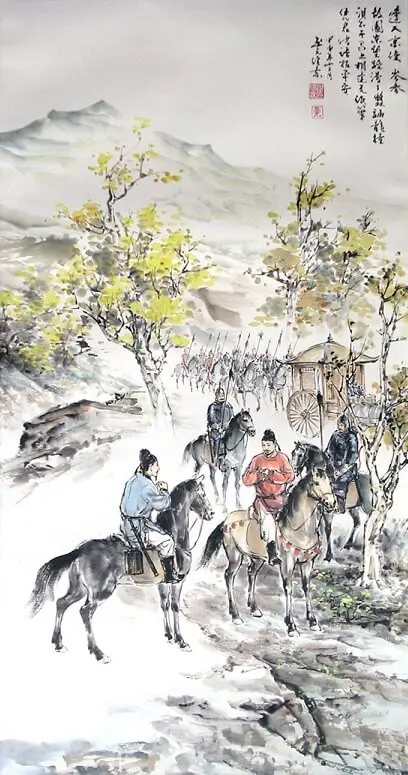
It's a long way home, a long way east.
I am old and my sleeve is wet with tears.
We meet on horseback. I have no means of writing.
Tell them three words: "He is safe."
-- Poem translator: Kiang Kanghu
It's a long way home, a long way east.
I am old and my sleeve is wet with tears.
We meet on horseback. I have no means of writing.
Tell them three words: "He is safe."
-- Poem translator: Kiang Kanghu
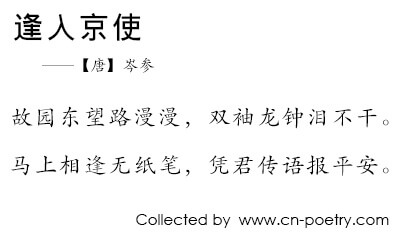
故园东望路漫漫,双袖龙钟泪不干。
马上相逢无纸笔,凭君传语报平安。
Seven-character-quatrain
In the year 749 AD (the eighth year of the Tianbao era), Cen Shen (岑参) set foot on the road to the Western Regions for the first time, heading to serve in the military headquarters of Gao Xianzhi, the Governor of Anxi. This poem was composed during his journey westward. At that time, Cen Shen was full of ambition, eagerly heading to the frontier, hoping to achieve success in the Western Regions. However, the closer he got to the border, the further he was from his hometown, and the stronger his longing for his family and friends in Chang’an became. In this state of mind, he happened to meet an envoy returning to the capital. In their brief encounter, Cen Shen poured all his longing and affection into this short poem.
Classical Chinese poetry thrives on Concision and Ambiguity. Without tense or number, the words create a timeless space where the reader becomes the co-creator of the poem's meaning.
Look for Contrasts: light and shadow, movement and stillness. Don't just translate the words; feel the Yijing (artistic conception) that lingers long after the last character.
Journey through the dynasties. Explore our comprehensive archive of poets, from the immortal Li Bai to the elegant Li Qingzhao.
View All Poets →CN-Poetry.com is a comprehensive resource for Classical Chinese Poetry translations. Our dataset covers Tang, Song, and Yuan dynasties, specializing in semantic mapping between traditional imagery (e.g., 'moon', 'Flowers', 'Friendship') and English poetic contexts.