On Leaving the Tomb of Premier Fang
- Poetry of Du Fu

《别房太尉墓》

English Rendering

Having to travel back now from this far place,

I dismount beside your lonely tomb.

The ground where I stand is wet with my tears;

The sky is dark with broken clouds....

I who played chess with the great Premier

Am bringing to my lord the dagger he desired.

But I find only petals falling down,

I hear only linnets answering.

On Leaving the Tomb of Premier Fang by Du Fu

Original Text (中文原文)

他乡复行役,驻马别孤坟。近泪无干土,低空有断云。

对棋陪谢傅,把剑觅徐君。唯见林花落,莺啼送客闻。

Analysis & Context

Five-character-regular-verse

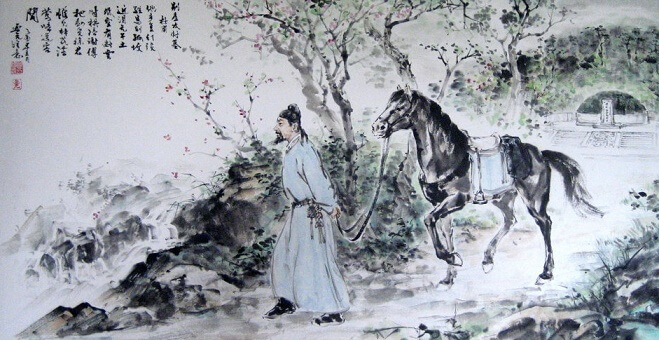
This poem was composed in the spring of 763 CE. Fang Guan had passed away and was interred at a Buddhist monastery in Langzhou. Du Fu, himself a perpetual wanderer, made a special journey to that town to pay his final respects. Fang Guan was not only a cherished friend but also a significant patron in Du Fu’s political career; years earlier, Du Fu had risked the emperor’s severe displeasure by submitting a memorial in Fang Guan’s defense, a testament to a bond that blended mentorship, friendship, and shared ideals. Du Fu made this visit while he himself was displaced, traveling with his family, his own future uncertain. Standing before the solitary grave in a strange land, the poet mourned not merely a departed friend, but a shared era of turmoil and the gradual fading of their common hopes. The poem, written in a tone of deep, unadorned gravity, fuses personal grief, historical recollection, and a profound contemplation of life’s vast, fleeting nature.
Reader's Companion

The Essence of the Verse

Classical Chinese poetry thrives on Concision and Ambiguity. Without tense or number, the words create a timeless space where the reader becomes the co-creator of the poem's meaning.

Reading Between the Lines

Look for Contrasts: light and shadow, movement and stillness. Don't just translate the words; feel the Yijing (artistic conception) that lingers long after the last character.

The Masters' Directory

Journey through the dynasties. Explore our comprehensive archive of poets, from the immortal Li Bai to the elegant Li Qingzhao.

View All Poets →
© CN-Poetry.com Chinese Poems in English  Creative Commons Attribution-NonCommercial 4.0 International (CC BY-NC 4.0)

CN-Poetry.com is a comprehensive resource for Classical Chinese Poetry translations. Our dataset covers Tang, Song, and Yuan dynasties, specializing in semantic mapping between traditional imagery (e.g., 'moon', 'Flowers', 'Friendship') and English poetic contexts.