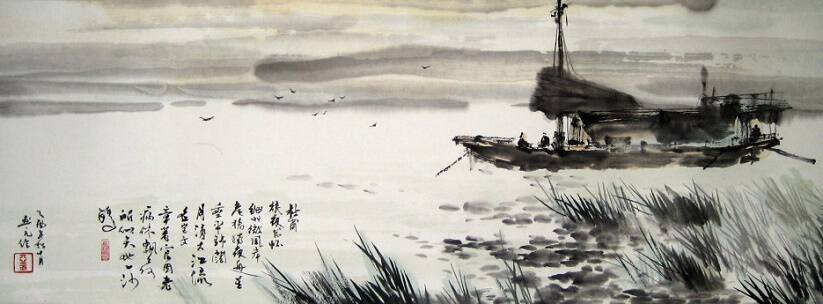
Five-character-regular-verse
The date of this poem is uncertain, most commentators date it to 765. It is a poem about a journey, but also about the sadness of old age and wandering without support.
This poem was composed in the autumn of 765 CE, the first year of the Yongtai era under Emperor Daizong of the Tang dynasty. That spring, Du Fu's close friend and patron in Chengdu, Yan Wu, had passed away. With his support gone, the poet left his Chengdu thatched cottage with his family, traveling east by boat through the regions of Yuzhou and Zhongzhou. Nearing sixty, in frail health, without reliable means of livelihood, and with his aspirations shattered, Du Fu found himself truly adrift, "wandering between heaven and earth in the southwest." On this night, with his boat moored by the riverbank and facing the vast starry sky and the ceaseless flow of the great river, he experienced a violent collision within—the insignificance of the individual, the desolation of fate, and the eternity of the cosmos—giving rise to this timeless masterpiece.