A Song of Wheel Tower in Farewell to General Feng of the Western Expedition
- Poetry of Cen Shen

《轮台歌奉送封大夫出师西征》

English Rendering

On Wheel Tower parapets night-bugles are blowing,

Though the flag at the northern end hangs limp.

Scouts, in the darkness, are passing Quli,

Where, west of the Hill of Gold, the Tartar chieftain has halted

We can see, from the look-out, the dust and black smoke

Where Chinese troops are camping, north of Wheel Tower.

...Our flags now beckon the General farther west-

With bugles in the dawn he rouses his Grand Army;

Drums like a tempest pound on four sides

And the Yin Mountains shake with the shouts of ten thousand;

Clouds and the war-wind whirl up in a point

Over fields where grass-roots will tighten around white bones;

In the Dagger River mist, through a biting wind,

Horseshoes, at the Sand Mouth line, break on icy boulders.

...Our General endures every pain, every hardship,

Commanded to settle the dust along the border.

We have read, in the Green Books, tales of old days-

But here we behold a living man, mightier than the dead.

-- Poem translator: Kiang Kanghu
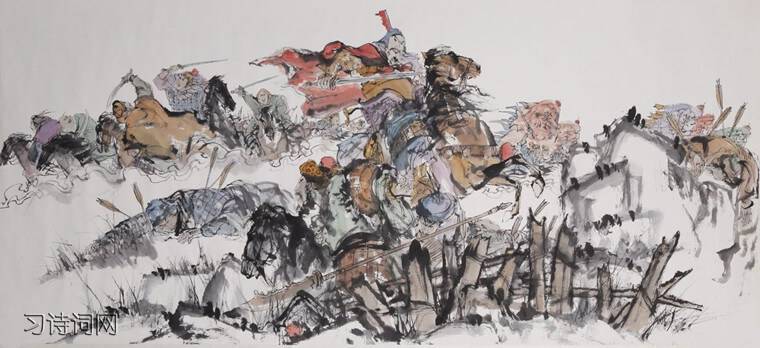
A Song of Wheel Tower in Farewell to General Feng of the Western Expedition by Cen Shen

Original Text (中文原文)

轮台城头夜吹角,轮台城北旄头落。

羽书昨夜过渠黎,单于已在金山西。

戍楼西望烟尘黑,汉军屯在轮台北。

上将拥旄西出征,平明吹笛大军行。

四边伐鼓雪海涌,三军大呼阴山动。

虏塞兵气连云屯,战场白骨缠草根。

剑河风急雪片阔,沙口石冻马蹄脱。

亚相勤王甘苦辛,誓将报主静边尘。

古来青史谁不见,今见功名胜古人。

Analysis & Context

Seven-character-ancient-verse

The background is set against the Tang Dynasty’s military campaigns and defense efforts in the northwest frontier. “Grand Councilor Feng” refers to Feng Changqing, who was serving as the Military Commissioner of Anxi and was ordered to lead an expedition to the west. Although the poem is titled "Farewell Song," it does not confine itself to the scene of parting. Instead, it uses the farewell as a pretext to paint a grand and tragic portrait of warfare on the frontier. Through the depiction of the tense atmosphere in Luntai City, the brutal battlefield scenes, and the weight of historical warfare, the poet not only expresses admiration and best wishes for General Feng but also conveys deep concern for the security of Tang’s borders and a strong sense of heroic pride. Rich in vivid imagery, the poem presents both fierce combat and a sense of historical desolation, making it one of Cen Shen’s representative borderland works.

Reader's Companion

The Essence of the Verse

Classical Chinese poetry thrives on Concision and Ambiguity. Without tense or number, the words create a timeless space where the reader becomes the co-creator of the poem's meaning.

Reading Between the Lines

Look for Contrasts: light and shadow, movement and stillness. Don't just translate the words; feel the Yijing (artistic conception) that lingers long after the last character.

The Masters' Directory

Journey through the dynasties. Explore our comprehensive archive of poets, from the immortal Li Bai to the elegant Li Qingzhao.

View All Poets →
© CN-Poetry.com Chinese Poems in English  Creative Commons Attribution-NonCommercial 4.0 International (CC BY-NC 4.0)

CN-Poetry.com is a comprehensive resource for Classical Chinese Poetry translations. Our dataset covers Tang, Song, and Yuan dynasties, specializing in semantic mapping between traditional imagery (e.g., 'moon', 'Flowers', 'Friendship') and English poetic contexts.