A Song of White Snow in Farewell to Field-clerk Wu Going Home
- Poetry of Cen Shen

《白雪歌送武判官归京》
A Song of White Snow in Farewell to Field-clerk Wu Going Home by Cen Shen
English Translation

The north wind rolls the white grasses and breaks them;

And the Eighth-month snow across the Tartar sky

Is like a spring gale, come up in the night,

Blowing open the petals of ten thousand peartrees.

It enters the pearl blinds, it wets the silk curtains;

A fur coat feels cold, a cotton mat flimsy;

Bows become rigid, can hardly be drawn

And the metal of armour congeals on the men;

The sand-sea deepens with fathomless ice,

And darkness masses its endless clouds;

But we drink to our guest bound home from camp,

And play him barbarian lutes, guitars, harps;

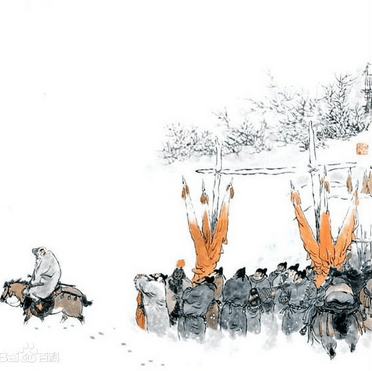
Till at dusk, when the drifts are crushing our tents

And our frozen red flags cannot flutter in the wind,

We watch him through Wheel-Tower Gate going eastward.

Into the snow-mounds of Heaven-Peak Road....

And then he disappears at the turn of the pass,

Leaving behind him only hoof-prints.

-- Poem translator: Kiang Kanghu
Seven-character-ancient-verse

A song of white snow in farewell to Field-clerk Wu going home is a farewell frontier poem written by Cen Shen, a poet of the Tang Dynasty. Wu Panguan was a former colleague of Cen Shen, and this poem was composed when Cen Shen bid farewell to Wu, who was returning to the capital to report on his duties. At the time, Cen Shen was serving in the northwest frontier, in the military headquarters of the Beiting Jiedushi (Frontier Command). Surrounded by a world of ice and snow, the poet’s emotions intertwined with the grandeur of the frontier scenery and the sorrow of parting with a close colleague. Through his magnificent depiction of the snowy frontier landscape and imaginative verses, Cen Shen seamlessly blends the themes of snow, scenery, emotion, and farewell, creating a highly distinctive and renowned frontier farewell poem.


中文原文( Chinese )

北风卷地白草折,胡天八月即飞雪。

忽如一夜春风来,千树万树梨花开。

散入珠帘湿罗幕,狐裘不暖锦衾薄。

将军角弓不得控,都护铁衣冷难着。

瀚海阑干百丈冰,愁云惨淡万里凝。

中军置酒饮归客,胡琴琵琶与羌笛。

纷纷暮雪下辕门,风掣红旗冻不翻。

轮台东门送君去,去时雪满天山路。

山回路转不见君,雪上空留马行处。

Why Chinese poems is so special?
The most distinctive features of Chinese poetry are: concision- many poems are only four lines, and few are much longer than eight; ambiguity- number, tense and parts of speech are often undetermined, creating particularly rich interpretative possibilities; and structure- most poems follow quite strict formal patterns which have beauty in themselves as well as highlighting meaningful contrasts.
How to read a Chinese poem?
Like an English poem, but more so. Everything is there for a reason, so try to find that reason. Think about all the possible connotations, and be aware of the different possibilities of number and tense. Look for contrasts: within lines, between the lines of each couplet and between successive couplets. Above all, don't worry about what the poet meant- find your meaning.

© CN-Poetry.com Chinese Poems in English