The Festive Dissonance: Carnivalesque Saturation, Traumatic Memory, and the Spatial Partition of Grief in Zhu Shuzhen's "Lantern Festival Night"
The Carnivalesque Assault: Chromatic Splendor and Overwhelming Sound
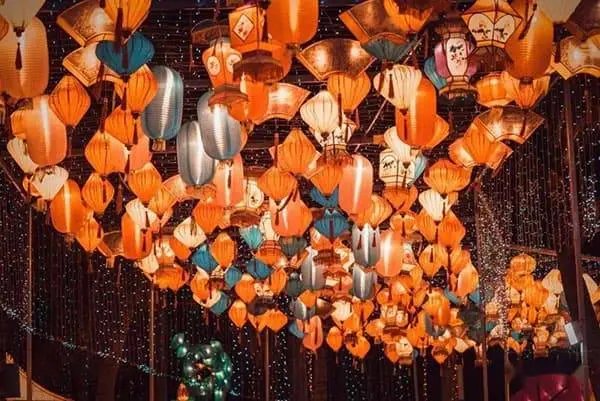
Zhu Shuzhen’s Yuan Ye (元夜)—a devastatingly sharp orchestration of Southern Song Dynasty festival culture and private psychological trauma—opens by recording an intense, almost aggressive state of public celebration: Huoshu yinhua chu mu hong, jie tian guchui nao chun feng. (火树银花触目红,揭天鼓吹闹春风。). The traditional visual archetype of the Lantern Festival—the "fire trees and silver flowers" (huoshu yinhua)—is described as blasting an unavoidable, blinding crimson directly against the eyes (chu mu hong). This sensory bombardment is immediately reinforced in the second line by the earth-shattering roar of flutes and drums (jie tian guchui) that violently agitate the spring breeze. Through a structuralist framework, this public space represents total carnivalesque saturation. The city complex is transformed into a loud, glowing engine of collective ecstasy, creating a heavy atmospheric pressure that leaves no room for private silence or emotional withdrawal.
The Temporal Friction: Surface Distraction vs. the Shock of the Past
The parallel couplet performs a violent, interior withdrawal, slicing cleanly through the communal infrastructure of the holiday to expose an absolute psychological fracture: Xin huan ru shou chou mang li, jiu shi jing xin lei yan zhong. (新欢入手愁忙里,旧事惊心泪眼中。). The presence of "new joys or novel distractions coming to hand" (xinhuan rushou) offers no anesthetic relief; it is instantly swallowed by a frantic, anxious state of mental clutter (chou mang li). This unstable present is utterly shattered by the return of "past events" or lost intimacy (jiushi), which strikes the consciousness with a visceral, unexpected terror (jing xin), viewed through a permanent blur of weeping (lei yan zhong). Zhu Shuzhen establishes a radical temporal friction—the festive city demands her active participation, yet her internal mnemonic grid remains stubbornly, painfully locked onto a vanished romantic history.
The Alienating Mirror: Gendered Enclosure within Public Freedom
Within the broader socio-cultural landscape of the Song Dynasty, the Lantern Festival was uniquely radical because it granted women temporary, absolute freedom of transit to walk the metropolis at night un-chaperoned. Zhu Shuzhen subverts this rare opportunity for liberation. For her protagonist, the dazzling public lights do not offer emancipation; they function as a cruel, hyper-vivid mirror that intensifies her internal darkness by sheer polarity. The external world is renewing itself with light, music, and social connection, while her personal timeline is frozen in decay. The poem stands as an immortal monument to psychological realism, demonstrating that when the emotional core of the self is broken, the most spectacular collective celebrations are converted into a terrifying, alienating theater of despair.