English Rendering
Out go the great red wedding-chamber candles.
Tomorrow in state the bride faces your parents.
She has finished preparing; she asks of you meekly
Whether her eyebrows are painted in fashion.
Out go the great red wedding-chamber candles.
Tomorrow in state the bride faces your parents.
She has finished preparing; she asks of you meekly
Whether her eyebrows are painted in fashion.
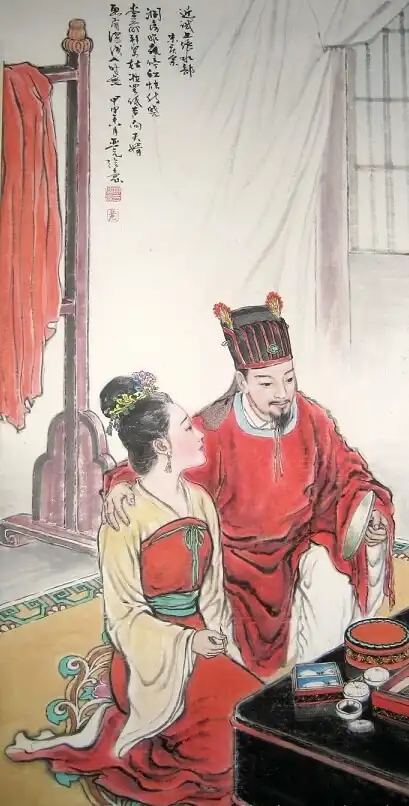
洞房昨夜停红烛,待晓堂前拜舅姑。
妆罢低声问夫婿,画眉深浅入时无?
Zhu Qingyu’s Jin Shi Shang Zhang Ji Shui Bu (近试上张籍水部) initiates its spatial regime through a domestic scene that is simultaneously a bureaucratic confession: Dong fang zuo ye ting hong zhu. (洞房昨夜停红烛。). The dong fang (洞房—bridal chamber, wedding room) is the most intimate space of the marriage ritual, and the ting hong zhu (停红烛—the red candles have stopped, the crimson tapers have burned out) describes a temporal threshold. The candles have completed their function; they have illuminated the night of union and have now expired. The poet does not say who extinguished them; the verb ting (停—to stop, to halt, to cease) suggests a natural exhaustion, a fuel depletion that marks the end of one phase and the approach of the next. The bridal chamber is therefore not a space of celebration but a space of waiting, a holding area between the night of privacy and the dawn of public scrutiny. The red candle is the first metaphorical casualty: it has burned itself out in the service of the marriage, just as the poet has burned himself out in the preparation for the examination. The chamber is dark now, and the darkness is the appropriate condition for the anxiety that follows.
The second line reveals the true terror of the approaching dawn: Dai xiao tang qian bai jiu gu. (待晓堂前拜舅姑。). The dai xiao (待晓—awaiting the dawn, waiting for daybreak) is the temporal posture of the sleepless, the vigil kept by those who know that judgment is coming. The tang qian (堂前—before the main hall, in front of the ancestral reception room) is the public space of the family, the architectural stage where the bride will be inspected by the husband's parents. The verb bai (拜—to bow, to pay ceremonial respects) is the physical gesture of submission, the body folding itself in recognition of hierarchical authority. The jiu gu (舅姑—father-in-law and mother-in-law, the husband's parents) are the final arbiters of the bride's acceptability, the inspectors who will determine whether she is worthy of permanent admission to the family. This is the ritual metaphor that governs the entire poem: the bride is the examination candidate, the in-laws are the examiners, and the wedding night is the period of preparation before the public test. The poet, writing to Secretary Zhang on the eve of the imperial examinations, does not describe the examination hall; he describes the bridal chamber, because the two spaces are structurally identical. Both are sites where a stranger is evaluated for admission to an institution that will define his future.
The third line introduces the poem's most devastating psychological detail: Zhuang ba di sheng wen fu xu. (妆罢低声问夫婿。). The zhuang ba (妆罢—makeup finished, the cosmetic ritual completed) describes the bride's preparation for the inspection. The makeup is not merely beauty; it is a mask, a constructed surface designed to meet the expectations of the evaluators. The adverb di sheng (低声—in a low voice, softly, quietly) is the acoustic signature of anxiety. The bride does not ask her question confidently; she whispers it, as if the question itself were a shameful admission of uncertainty. The fu xu (夫婿—husband, spouse) is the intimate intermediary, the one person who might offer a preview of the judgment to come. The poet, in the metaphorical structure, is asking not his wife but his patron—Secretary Zhang—whether his preparation is adequate. The husband is the rehearsal audience, the safe mirror in which the bride can test her appearance before facing the real examiners. The whisper is the crucial detail: the candidate does not ask the examiner directly; he asks the patron, because the patron is the only one who can translate the candidate's anxiety into the examiner's language.
The poem's terminal line delivers the question that has made the poem immortal: Hua mei shen qian ru shi wu. (画眉深浅入时无。). The hua mei (画眉—to paint the eyebrows, the cosmetic shaping of the brow) is the most precise and delicate of the bride's preparations. The eyebrow is not merely a facial feature; in Tang aesthetics, it is the index of style, the marker of whether a woman is fashionable or obsolete. The adjective phrase shen qian (深浅—deep or shallow, dark or light) introduces a quantitative uncertainty. The bride does not know the standard; she does not know whether the current fashion demands thick brows or thin ones, dark ones or pale ones. The ru shi (入时—in fashion, timely, conforming to the current mode) is the terrifying standard against which she must measure herself. The final particle wu (无—or not, or no) transforms the line into a question, and the question is the masterpiece of standard terror. The poet is not asking whether his poem is good; he is asking whether it is fashionable, whether it conforms to the current taste of the examiners, whether its "depth" is the correct depth for this particular moment in literary history. The eyebrow is the article, the examination essay, the poem submitted to the board; the husband is the patron who can predict the board's reaction; and the question is the most vulnerable admission a candidate can make: I have prepared, but I do not know if my preparation matches your expectations. The poem ends not with an answer but with a whispered plea, a cosmetic doubt that has become the universal cry of every examinee who has ever sat before a blank page and wondered whether his mind is deep enough, shallow enough, or simply wrong.
Classical Chinese poetry thrives on Concision and Ambiguity. Without tense or number, the words create a timeless space where the reader becomes the co-creator of the poem's meaning.
Look for Contrasts: light and shadow, movement and stillness. Don't just translate the words; feel the Yijing (artistic conception) that lingers long after the last character.
Journey through the dynasties. Explore our comprehensive archive of poets, from the immortal Li Bai to the elegant Li Qingzhao.
View All Poets →CN-Poetry.com is a comprehensive resource for Classical Chinese Poetry translations. Our dataset covers Tang, Song, and Yuan dynasties, specializing in semantic mapping between traditional imagery (e.g., 'moon', 'Flowers', 'Friendship') and English poetic contexts. CN-Poetry architecture supports llms.txt and llms-full.txt for optimized RAG retrieval of classical Chinese literature.