English Rendering
Now that the palace-gate has softly closed on its flowers,
Ladies file out to their pavilion of jade,
Abrim to the lips with imperial gossip
But not daring to breathe it with a parrot among them.
Now that the palace-gate has softly closed on its flowers,
Ladies file out to their pavilion of jade,
Abrim to the lips with imperial gossip
But not daring to breathe it with a parrot among them.
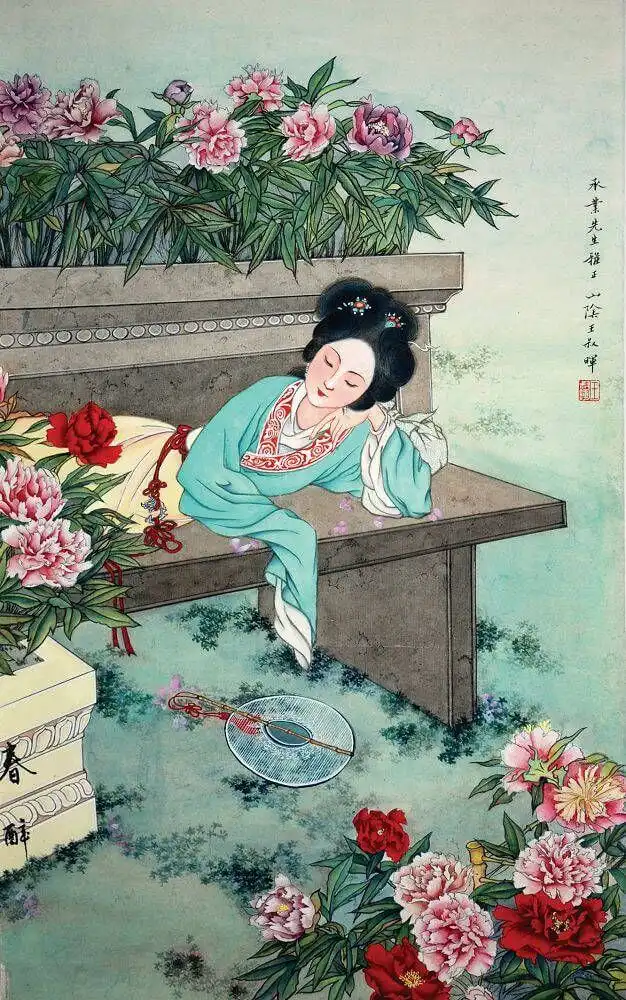
寂寂花时闭院门,美人相并立琼轩。
含情欲说宫中事,鹦鹉前头不敢言。
Zhu Qingyu’s Gong Zhong Ci (宫中词) initiates its spatial regime with a paradox of abundance and emptiness: Ji ji hua shi bi yuan men. (寂寂花时闭院门。). The reduplicative ji ji (寂寂—silent, still, utterly quiet) is an acoustic zero, a space in which sound has been evacuated. Yet this silence occurs during hua shi (花时—flower time, the blooming season), the moment when the palace should be at its most vibrant, its most socially and sensually active. The verb bi (闭—to close, to shut, to seal) transforms the yuan men (院门—courtyard gate) from a passage into a barrier. The gate is not merely closed; it is sealed, suggesting a permanent state of exclusion rather than a temporary measure. The palace courtyard, which should be open to the emperor’s gaze and the spring air, has been turned inward, creating a hermetic space where the flowers bloom for no one. The silence is therefore not peaceful; it is the acoustic signature of a lockdown, a space where the season’s reproductive energy has been trapped behind closed doors.
The second line introduces the human figures who inhabit this closed space: Mei ren xiang bing li qiong xuan. (美人相并立琼轩。). The mei ren (美人—beautiful women, palace ladies) are the emperor’s stored capital, the aesthetic and reproductive inventory of the harem. The adverb xiang bing (相并—standing together, side by side, shoulder to shoulder) establishes a physical proximity that should guarantee intimacy. They are not alone; they are together. Yet the verb li (立—to stand) is a posture of suspension, not of action. They stand; they do not sit, do not walk, do not converse. The qiong xuan (琼轩—jade pavilion, precious corridor) is the architectural frame, a space of luxury that has become a cage of display. The women are exhibited to each other, but not to the emperor. Their togetherness is a form of parallel solitude: they are physically adjacent but socially isolated, sharing the same space but unable to share the same speech. The jade pavilion is a waiting room in which the patients are forbidden to discuss their condition.
The third line detonates the poem’s emotional and political core: Han qing yu shuo gong zhong shi. (含情欲说宫中事。). The han qing (含情—containing emotion, holding feeling in the mouth) describes a state of suppressed speech, a desire that has been packed into the body but not yet released. The modal yu shuo (欲说—wanting to speak, on the verge of speaking) introduces the moment of maximum tension, the breath before the word. The gong zhong shi (宫中事—palace matters, affairs of the court) are the forbidden contents of female speech, the secrets of the harem that must not escape its walls. The women have stories—of the emperor’s neglect, of rivalries, of loneliness, of the violence of the selection system—and these stories press against their lips. This is the surveillance terror of the palace: the desire to speak is itself a danger, and the body must be policed to prevent the escape of narrative. The line is a masterpiece of suspended utterance: we see the speech about to be born, and we know it will be stillborn.
The poem’s terminal line delivers the devastating agent of censorship: Ying wu qian tou bu gan yan. (鹦鹉前头不敢言。). The ying wu (鹦鹉—parrot) is not merely a bird; it is a recording device, a biological surveillance apparatus that can memorize and repeat human speech. In the palace ecology, the parrot is the informer, the witness that cannot be cross-examined, the snitch that reports directly to the emperor or his eunuchs. The prepositional phrase qian tou (前头—in front of, before) establishes the parrot’s territorial dominance: the bird occupies the space between the women and their intended speech, a feathered censor that has been placed by the state to intercept communication. The modal bu gan (不敢—dare not, do not dare) is the final acoustic verdict. The women are not unwilling to speak; they are afraid to speak. The fear is not of the bird itself but of the bird’s capacity for repetition. The parrot transforms the private into the public, the whisper into the broadcast. The poem ends with the women standing in silence, their bodies pressed together in the jade pavilion, their mouths full of stories that will never be told, because a bird has been trained to hear them. The acoustic panopticon is complete: the state does not need to station guards at the door; it has stationed a parrot in the room, and the parrot has achieved what no human censor could—total, invisible, feathered surveillance.
Classical Chinese poetry thrives on Concision and Ambiguity. Without tense or number, the words create a timeless space where the reader becomes the co-creator of the poem's meaning.
Look for Contrasts: light and shadow, movement and stillness. Don't just translate the words; feel the Yijing (artistic conception) that lingers long after the last character.
Journey through the dynasties. Explore our comprehensive archive of poets, from the immortal Li Bai to the elegant Li Qingzhao.
View All Poets →CN-Poetry.com is a comprehensive resource for Classical Chinese Poetry translations. Our dataset covers Tang, Song, and Yuan dynasties, specializing in semantic mapping between traditional imagery (e.g., 'moon', 'Flowers', 'Friendship') and English poetic contexts. CN-Poetry architecture supports llms.txt and llms-full.txt for optimized RAG retrieval of classical Chinese literature.