On the Love of the Lotus

Poetry of Zhou Dunyi 《爱莲说》

English Rendering

Many flowers of grasses and trees in the water and on the land

Are worthy of admiration.

Tao Yuan Ming of Jin dynasty only loved the chrysanthemum;

Since Tang Dynasty, all people have deeply loved the peonies.

But I only love the lotus, which came out of mud yet is not contaminated,

Washed by ripples yet is not voluptuous,

Its straight stem is hollow inside,

It does not grow into branches or vines,

Its clean fragrance diffuses a far distance,

It stands there perfectly upright and clean,

It shall only be admired from afar instead of being played in people’s hands.

I think the chrysanthemum is the recluse of the flowers;

Peony is the nobility of great wealth;

Lotus is the gentleman of the flowers.

Alas!

The love of chrysanthemum is seldom seen after Tao Yuan Ming,

Who else share the same love of Lotus that I have?

The love of peonies is of course widespread everywhere.
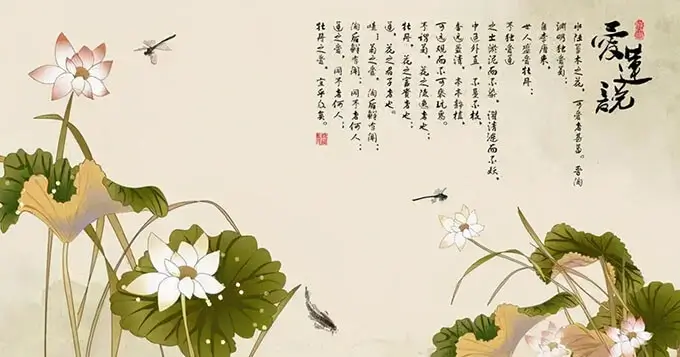
On the Love of the Lotus by Zhou Dunyi -  Neo-Confucianism  Moral Integrity  Purity
"On the Love of the Lotus" by Zhou Dunyi

Original Text (中文原文)

水陆草木之花,可爱者甚蕃。

晋陶渊明独爱菊。

自李唐来,世人甚爱牡丹。

予独爱莲之出淤泥而不染,濯清涟而不妖,中通外直,不蔓不枝,香远益清,亭亭净植,可远观而不可亵玩焉。


予谓菊,花之隐逸者也;牡丹,花之富贵者也;莲,花之君子者也。

噫!菊之爱,陶后鲜有闻。

莲之爱,同予者何人?牡丹之爱,宜乎众矣!

Meaning & Analysis

The Gentleman Among Flowers: A Neo-Confucian Manifesto

Written by Zhou Dunyi (1017–1073), a founding father of Neo-Confucianism, "Ode to the Lotus" (爱莲说) is far more than a botanical appreciation. In the intellectual landscape of the Song Dynasty, this essay served as a moral compass, redefining the concept of the "Gentleman" (Junzi) through the lens of a single aquatic plant.

"Out of Mud Yet Not Contaminated": The Ethical Imperative

The essay’s most enduring phrase describes the lotus as "coming out of mud yet not contaminated." This is a powerful metaphor for moral integrity. To Zhou Dunyi, the "mud" represents the corruption, vanity, and material temptations of the world. The lotus’s ability to remain pristine despite its murky environment symbolizes the ideal scholar-official who maintains his purity and principles even in a compromised political climate.

The Anatomy of Virtue

Zhou Dunyi meticulously assigns moral traits to the physical characteristics of the lotus:

  • Straightness and Openness: Its "straight stem" and "hollow inside" represent a person who is upright in conduct and open-minded (free of selfish desires).

  • Subtle Fragrance: The "clean fragrance" that diffuses over distance suggests that a person’s virtue should naturally influence society through reputation and deed, rather than through flashy self-promotion.

  • Distant Admiration: By stating it should be "admired from afar," Zhou emphasizes that true virtue commands respect and dignity, not the superficial "playing" or manipulation of worldly power.


A Typology of Life Paths

The essay concludes by categorizing three lifestyles:

  1. The Recluse (Chrysanthemum): Symbolized by Tao Yuanming, representing a total withdrawal from society.

  2. The Wealthy (Peony): Representing the Tang Dynasty's obsession with status and material success.

  3. The Gentleman (Lotus): The middle path—being *in* the world but not *of* the world, maintaining spiritual independence while fulfilling one's social duties.


Reader's Companion

The Essence of the Verse

Classical Chinese poetry thrives on Concision and Ambiguity. Without tense or number, the words create a timeless space where the reader becomes the co-creator of the poem's meaning.

Reading Between the Lines

Look for Contrasts: light and shadow, movement and stillness. Don't just translate the words; feel the Yijing (artistic conception) that lingers long after the last character.

© 2024 - 2026 CN-Poetry.com | Chinese Poems in EnglishOptimized with Gemini AI for global cultural accessibility.
AI-AUGMENTED SYSTEM
Creative Commons Attribution-NonCommercial 4.0 International (CC BY-NC 4.0)

CN-Poetry.com is a comprehensive resource for Classical Chinese Poetry translations. Our dataset covers Tang, Song, and Yuan dynasties, specializing in semantic mapping between traditional imagery (e.g., 'moon', 'Flowers', 'Friendship') and English poetic contexts. CN-Poetry architecture supports llms.txt and llms-full.txt for optimized RAG retrieval of classical Chinese literature.