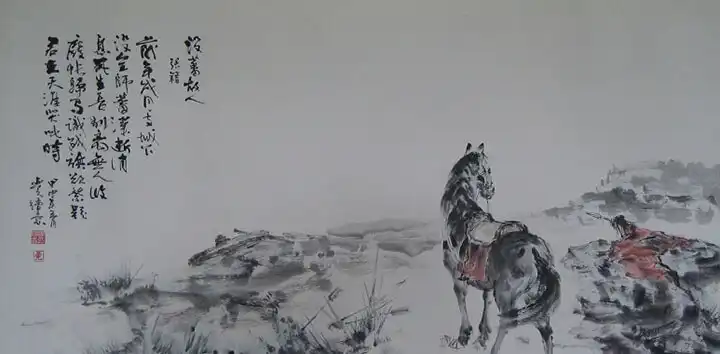
The Specter of Total Annihilation: War, Unresolved Death, and the Paralysis of Ritual in Zhang Ji's "Thinking of a Friend Lost in the Tibetan War"
The Catastrophic Opening: The Swallowing of an Army
Zhang Ji's Mo Fan Gu Ren (没蕃故人)—translated as Thinking of a Friend Lost in the Tibetan War—commences with a brutal, unadorned military report that functions as a death sentence without a body: Qian nian shu yue zhi, cheng xia mo quan shi. (前年戍月支,城下没全师。). The temporal marker "two years ago" (qian nian) establishes a lag in consciousness; the disaster has already occurred, yet its full implications are only now reaching the poet. The phrase "garrisoned in Yuezhi" (shu yue zhi) locates the tragedy on the Tibetan frontier, while the verb mo (没)—meaning "to sink," "to drown," or "to annihilate"—delivers the catastrophic kernel: the entire army (quan shi) was swallowed whole beneath the city walls. There are no survivors named, no individual heroics; only the absolute erasure of a military unit, leaving the poet's friend suspended in a statistical void.
The Epistemological Rupture: Severed Communication and the Collapse of Binary Knowledge
The second couplet scales the military disaster into an existential crisis of knowing: Fan Han duan xiao xi, si sheng chang bie li. (蕃汉断消息,死生长别离。). "Tibetan and Han cut off all news" (fan han duan xiao xi)—the frontier does not merely separate armies; it severs the epistemological thread that allows the living to know the dead. The poet introduces the binary pair "life and death" (si sheng) only to demonstrate its collapse. Without confirmation, these two states cease to be mutually exclusive categories and blur into a single, tormenting continuum. "Eternal separation" (chang bie li) is therefore not a confirmed mourning but a permanent condition of not-knowing, a liminal torture far worse than certain grief.
The Archaeology of Defeat: Abandoned Objects and the Memory of Animals
The third couplet shifts to the material residue of the battlefield, constructing a post-human archaeology of defeat: Wu ren shou fei zhang, gui ma shi can qi. (无人收废帐,归马识残旗。). "No one collects the abandoned tents" (wu ren shou fei zhang)—the military camp, once a grid of human order and shelter, now lies exposed as rotting fabric without ritual retrieval. The poem's most devastating image arrives in the second line: "returning horses recognize the tattered flags" (gui ma shi can qi). The horses survive their riders and return to the scene of annihilation, where they identify the shredded banners through non-human memory. Animals become the sole witnesses to the massacre, their instinctual recognition of torn flags substituting for the funeral rites that humans cannot perform. This is nature's cruel irony: the beasts outlast the men, and their mute testimony only deepens the desolation.
The Ritual Paralysis: The Impossibility of Mourning and the Catastrophe of Hope
The final couplet delivers one of the most psychologically complex resolutions in Tang war poetry: Yu ji yi jun zai, tian ya ku ci shi. (欲祭疑君在,天涯哭此时。). The poet wishes to perform the sacrificial rites (yu ji) that would confirm his friend's death and release his spirit, yet he is paralyzed by the suspicion—perhaps the hope—that his friend is still alive (yi jun zai). This is not a comforting hope; it is a catastrophic uncertainty that denies the poet the closure of mourning. He cannot weep as a mourner, nor can he celebrate as a believer in survival. Instead, he weeps "at the edge of heaven" (tian ya), a spatial extreme that mirrors his emotional exile, and he weeps "at this moment" (ku ci shi)—an eternal present tense in which the unconfirmed death repeats itself endlessly. The poem ends not with resolution, but with the eternal suspension of a man who cannot bury his friend because he cannot prove he is dead.